
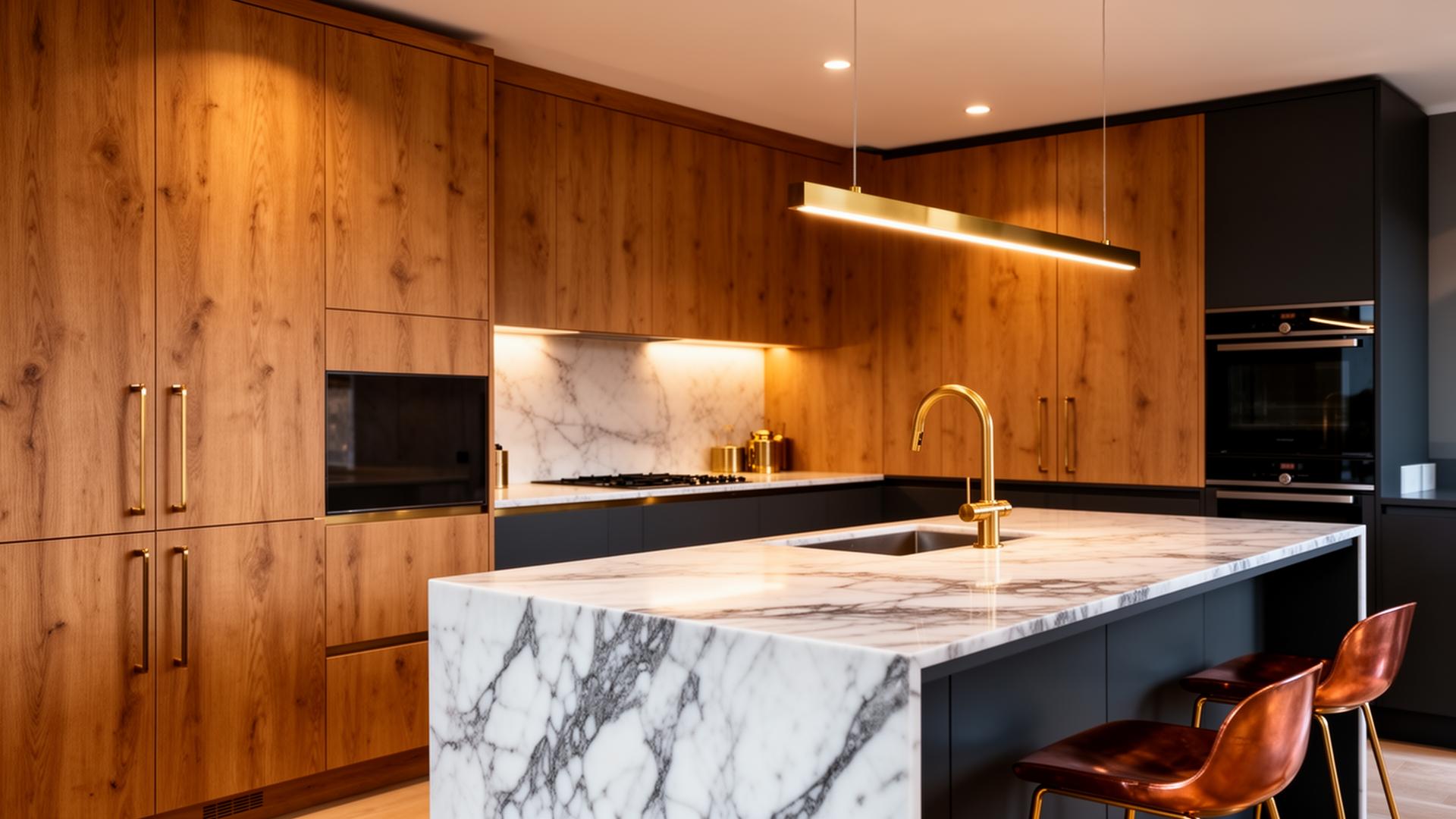
Moisture-resistant medium-density fibreboard, usually shortened to MR-MDF, is manufactured from wood fibres bound under heat and pressure with a resin that gives it more tolerance of damp environments than standard MDF.
It's become the default substrate for painted and sprayed fitted furniture for good reason, but it isn't a universal substitute for solid timber and shouldn't be specified where its limits are exceeded.
Where it's the right substrate
Fitted kitchen doors, wardrobe doors, panelling and any painted or sprayed furniture surface benefits from MDF's completely flat, grain-free face, which takes a sprayed finish smoother and more consistently than solid timber, where grain and movement would show through the paint over time.
Because it doesn't move seasonally the way solid timber does, MR-MDF holds tight, consistent gaps between doors and drawers over years of use, which matters a great deal in a fitted kitchen where alignment is judged at a glance.
Where it's the wrong material
Anywhere it will be in prolonged contact with standing water — directly under a sink cut-out with a poor seal, or in an unventilated bathroom cupboard base — MR-MDF will eventually swell at the exposed edge, even with the moisture-resistant additive, because the resistance is relative rather than waterproof.
It has no real structural strength in tension or as a load-bearing member, so it's the wrong choice for open shelving spanning any real distance or for anything expected to carry significant point loads without support behind it.
Edge treatment and why it matters
Every cut edge of MDF is more absorbent than the face, since the fibres are exposed rather than compressed under the resin skin, so edges have to be sealed — usually primed and filled, or lipped with a solid timber edge — before the item goes anywhere near moisture.
A cabinet with an unsealed or poorly primed cut edge sitting near a sink, dishwasher or washing machine is one of the most common causes of swollen, blown furniture we're called to replace, and it's entirely avoidable at the specification stage.
Fixings and hardware in MDF
MDF holds a screw thread less securely than solid timber, particularly near a board edge, so hinges, handles and drawer runners are best fixed with confirmat-style screws designed for board material, or backed with a solid timber lipping where repeated opening and closing puts real strain on the fixing point.
Cam-and-dowel knock-down fittings, common in flat-pack and factory-made carcasses, work reliably in MDF because the load is spread across a wider bearing area than a single screw thread, which is one reason they're specified so consistently in factory-made furniture carcasses.
What a furniture specification should state
A written specification for painted MDF furniture should name the board grade, confirm which edges get extra sealing treatment, and state the number of spray coats, because all three of those affect how the finished piece performs near moisture even though none of them are visible once it's installed.
It's also worth having the specification state who is responsible for sealing any site-cut edges — for example where a worktop cut-out is adjusted on site — since factory-applied edge sealing doesn't extend to a cut made after delivery unless it's specifically addressed.
Common questions
Is MR-MDF waterproof?+
No — it's moisture-resistant, meaning it copes better with humidity and occasional damp than standard MDF, but it isn't waterproof and will swell if a cut edge is left unsealed and exposed to standing water.
Why do painted kitchen doors use MDF instead of solid wood?+
MDF has no grain to telegraph through a sprayed finish and doesn't move seasonally, so painted doors stay flat and keep consistent gaps for years, which solid timber doors are more prone to losing as they move with humidity changes.
Can MDF be used for open shelving?+
For light duty and well-supported shelving over short spans it's fine, but for longer spans or heavier loads it will sag over time, and a solid timber or engineered board with more stiffness should be specified instead.
Ask us about the right substrate for your fitted furniture
We'll specify MR-MDF where it's the right choice and flag anywhere it isn't, particularly near sinks and wet areas.