
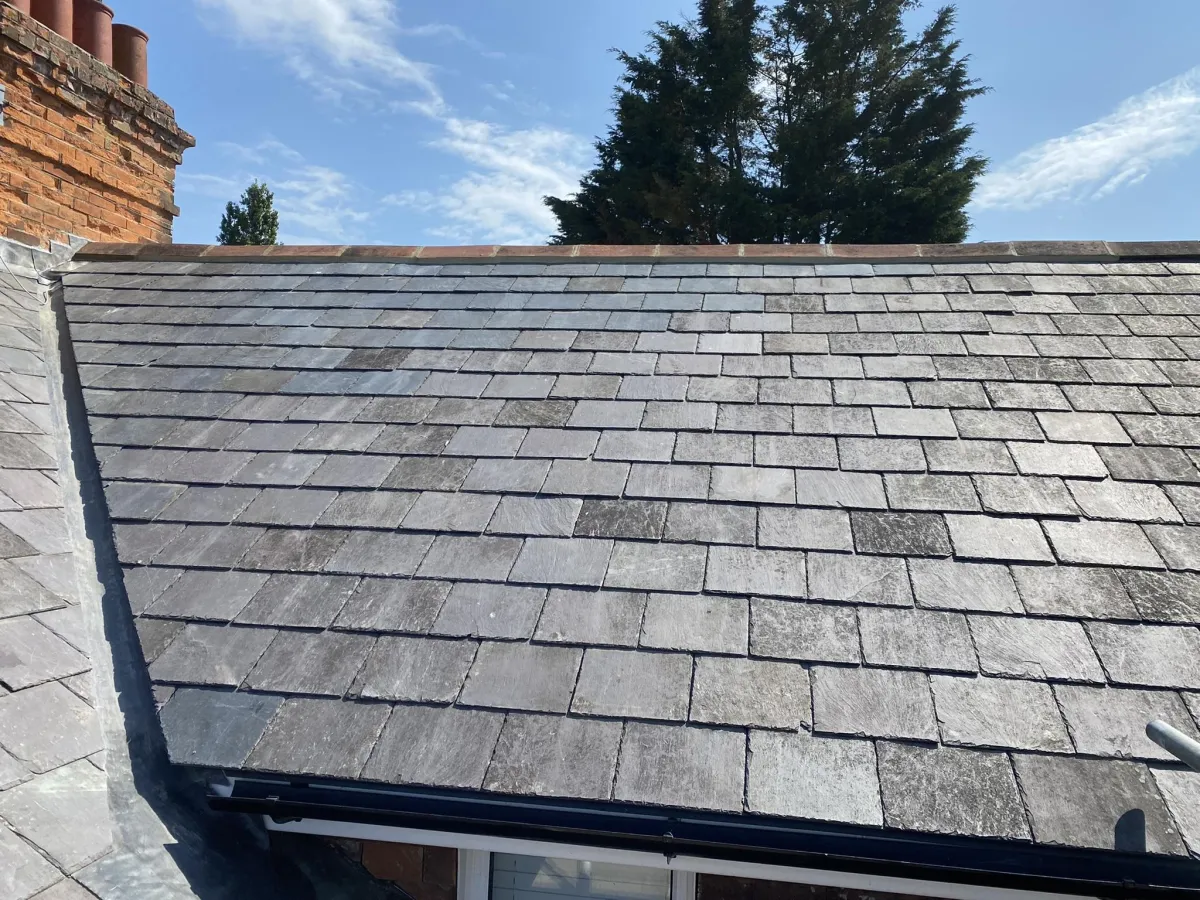
Clay peg tiles are small, flat clay tiles — traditionally around 265mm long — hung on timber battens using two clay pegs or, on more modern work, nails through pre-formed holes near the top edge. They're the traditional covering across the Weald, used on both pitched roofs and vertical tile hanging on walls.
In Kent specifically, they carry real conservation weight: on a listed building or inside a conservation area, a like-for-like clay peg tile is very often the only covering a council will accept.
Handmade versus machine-made
Handmade tiles have natural irregularities in shape, thickness and colour, which give a period roof its characteristic slightly uneven, textured look when laid. Machine-made tiles are more uniform and cheaper, but read differently on a roof, especially next to older surviving tiles.
On a listed building or in a sensitive conservation setting, a conservation officer will often specify handmade tiles matched to the existing roof; on a less sensitive re-roof, machine-made tiles in a similar colour can be an acceptable and more affordable match.
Where it belongs
Period roofs across the Weald — farmhouses, oast conversions, weatherboarded cottages — are the obvious home for clay peg tiles, along with vertical tile hanging on upper storeys, a very common Kent detail on timber-framed and later brick houses alike.
Any repair inside a conservation area, even a partial one, generally needs to match the existing covering, which usually means clay peg tiles regardless of what the rest of the brief might otherwise suggest.
Where it's the wrong call, and what we specify instead
On a modern extension to a period house where the roof structure hasn't been designed for the weight, clay peg tiles are the wrong specification until a structural engineer has confirmed the roof timbers and any supporting walls can take the load — clay tiling is genuinely heavy compared with concrete interlocking tiles or slate.
Where a homeowner wants a lighter, lower-cost covering on a non-designated, non-visible roof slope — a rear outbuilding, for example — we'd specify a concrete interlocking tile instead, reserving the cost and weight of clay peg tiles for where planning or character genuinely demands it.
Gauge, lap and how peg tiles are actually hung
Peg tiles are hung in a double-lap pattern, each tile overlapping the two below it, with the gauge (the exposed spacing between batten rows) traditionally tighter than on a large interlocking concrete tile — often around 100mm — which is part of why a peg tile roof needs more tiles per square metre and more labour to lay.
Historically the tiles hung on their pegs over riven oak battens bedded on lime mortar torching for weatherproofing; modern re-roofing generally uses treated softwood battens and a breathable membrane beneath, with the tiles nailed rather than relying on pegs alone, while keeping the traditional gauge and bond visible from the ground.
Ready to do the work? Read our practical guide: repairing and re-roofing Kent peg tile roofs.
Common questions
Do I have to use clay peg tiles on a listed building?+
In most cases, yes, if the existing roof is clay peg tile — a conservation officer will generally require like-for-like replacement. We can advise based on the specific listing and council before you commit to a spec.
Are handmade tiles worth the extra cost over machine-made?+
On a visible, sensitive roof, generally yes, because the texture and colour variation reads correctly next to existing period fabric. On a less visible or non-designated roof, machine-made tiles are a reasonable and cheaper alternative.
Can clay peg tiles go on any roof structure?+
Only if the structure has been checked for the load — clay tiling is heavy, and an older roof or a new extension needs that confirmed by a structural engineer before tiling is specified.
Get advice on clay peg tiles for your roof
We work regularly with clay peg tiles on conservation-area and listed roofs across Kent, and we'll tell you plainly what your council is likely to require.