
Quartz worktop quotes often lead with a per-metre price, but that figure only tells part of the story. The real spread between quotes comes from slab thickness, how many cut-outs are needed, the edge profile chosen and how seams are placed.
Reading a quote properly means checking these line items are actually specified, not assumed.
Slab grade and thickness
Quartz is sold in different collections at different price points depending on pattern complexity and resin quality, and in standard thicknesses — commonly 20mm or 30mm. A 30mm worktop costs more in material but needs no build-up strip underneath to look substantial at the front edge, which a 20mm top usually does.
Templating and access
Quartz is templated on site after the units are fitted, then cut off site at the fabricator's workshop before final installation — this two-visit process is built into every proper quote and adds a fixed gap to the programme regardless of the job size.
Awkward access to the kitchen — narrow hallways, tight stairs, no ground-floor delivery route — increases the cost of getting large, heavy slab sections into the room without damage, and should be flagged before templating, not discovered on install day.
Cut-outs and seams
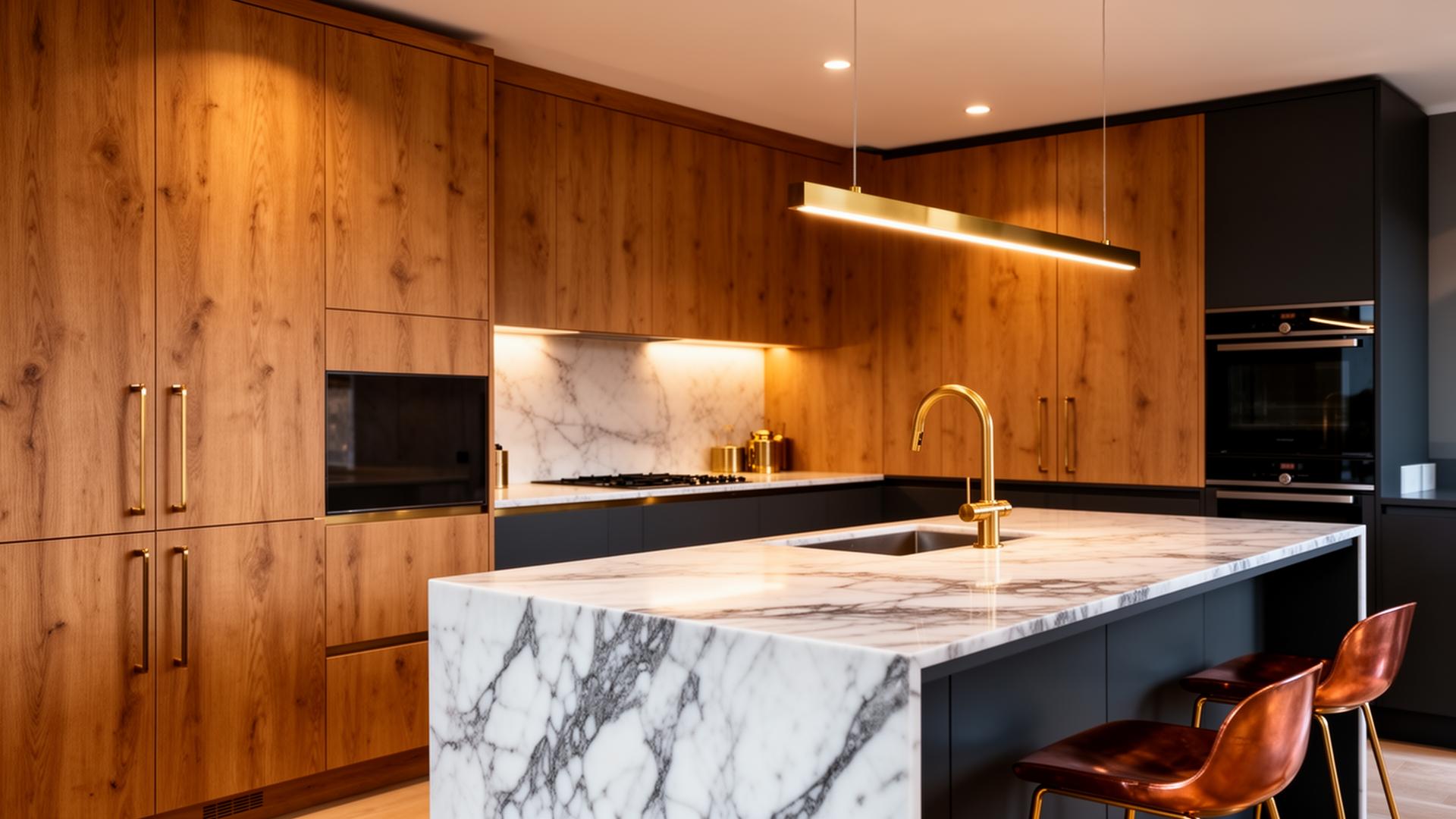
Every sink, hob and socket cut-out is a separate cost, because each one requires precision cutting on the slab and increases the risk of wastage on that section. An undermount sink cut-out, which leaves a polished internal edge, costs more than a simple hob aperture.
Seam placement matters too — a fabricator will try to place any unavoidable seam away from the sink and in the least visible run, but the more complex the layout, the more seams may be needed, each one adding fabrication time.
Edge profiles and wastage
A simple pencil-round edge is the cheapest option; a mitred or waterfall edge that wraps down the side of an island takes considerably more slab material and machining time.
Wastage is unavoidable with natural-pattern-matching slabs cut around a specific kitchen layout, and a fabricator working from a smaller or cheaper slab may need to introduce more seams to avoid wastage, which a cheaper quote sometimes doesn't disclose upfront.
- 20mm vs 30mm
- Thicker slab costs more but avoids a build-up strip at the front edge
- Undermount sink cut-out
- More than a simple hob aperture — requires a polished internal edge
- Mitred or waterfall edge
- More slab material and machining time than a pencil-round edge
- Seam count
- Driven by layout complexity and slab size available
Common questions
Why does templating add time to the programme?+
Templating has to happen after units are fitted and level, and the slab is then cut off site at the fabricator's workshop — that turnaround is fixed and can't be skipped without risking a poor fit.
Is a waterfall edge worth the extra cost?+
It's a design choice rather than a functional one — it uses considerably more material and machining, so it's worth it if the look matters to you, not otherwise.
Why do some quotes have more seams than others?+
Seam count depends on the layout and the slab sizes the fabricator is working from. A cheaper quote sometimes uses smaller or lower-grade slabs, which forces extra seams to cover the same run.
Get an itemised quartz worktop quote
Our quotes break out slab grade, cut-outs, edge profile and seam placement so you can see exactly what you're paying for.