
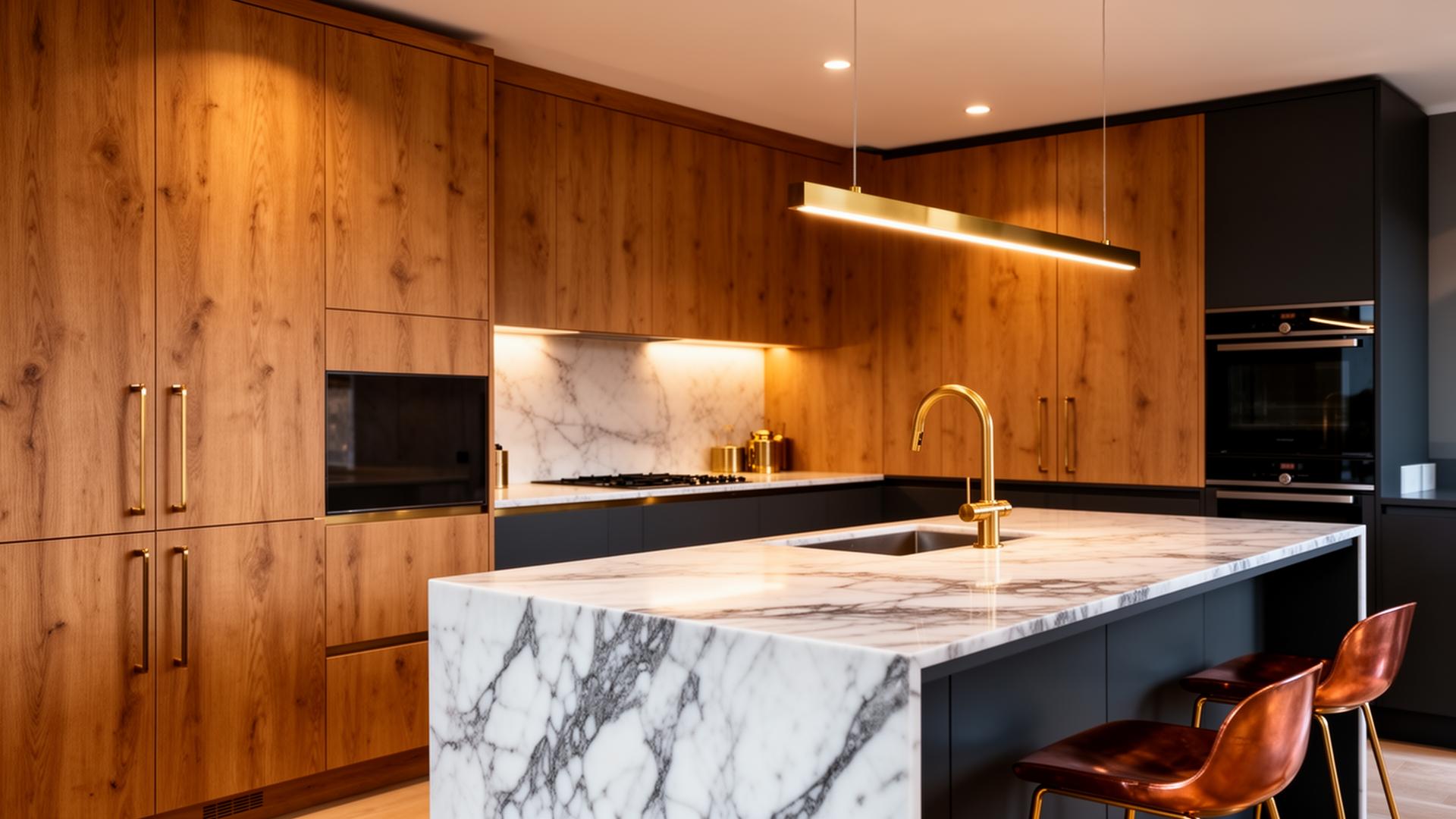
Templating and fitting also affect the programme: stone is templated after the units are in and takes time to fabricate, so the kitchen is unusable for a period in the middle of the job.
Engineered and natural stone
Quartz is consistent in colour, non-porous and low maintenance, but it can mark with sustained heat. Granite is natural, so every slab differs, and it tolerates heat better but needs occasional sealing.
Sintered surfaces sit at the top for heat and scratch resistance and allow very slim profiles, at a higher cost per metre.
Timber and laminate
Solid timber is warm, repairable and comparatively affordable, and it is the one surface you can sand back after years of use. It needs oiling and careful detailing around sinks.
Modern laminates look far better than their reputation, cost the least, and are entirely practical. Their weakness is water at cut edges and the fact that damage cannot be repaired.
Practical planning points
Plan joints, upstands, drainer grooves, sockets and any undermounted sink before templating, because those decisions are locked in once fabrication starts.
Overhangs for seating need support designed in. A long unsupported run in stone is a real structural consideration, not just a styling choice.
Common questions
Which worktop is the most durable?
Sintered surfaces and granite handle heat and scratching best. Quartz is very hard-wearing but less forgiving of hot pans placed directly on it.
Do timber worktops stain?
They can, particularly around sinks, but they are the only common surface that can be sanded and re-oiled back to as-new.
Why does stone take so long to fit?
It is templated after the units are installed and then fabricated off site, so there is normally a gap of a couple of weeks in the middle of the job.
Is laminate a false economy?
Not necessarily. It performs well for years; the limitation is that edge damage and water ingress cannot be repaired.