
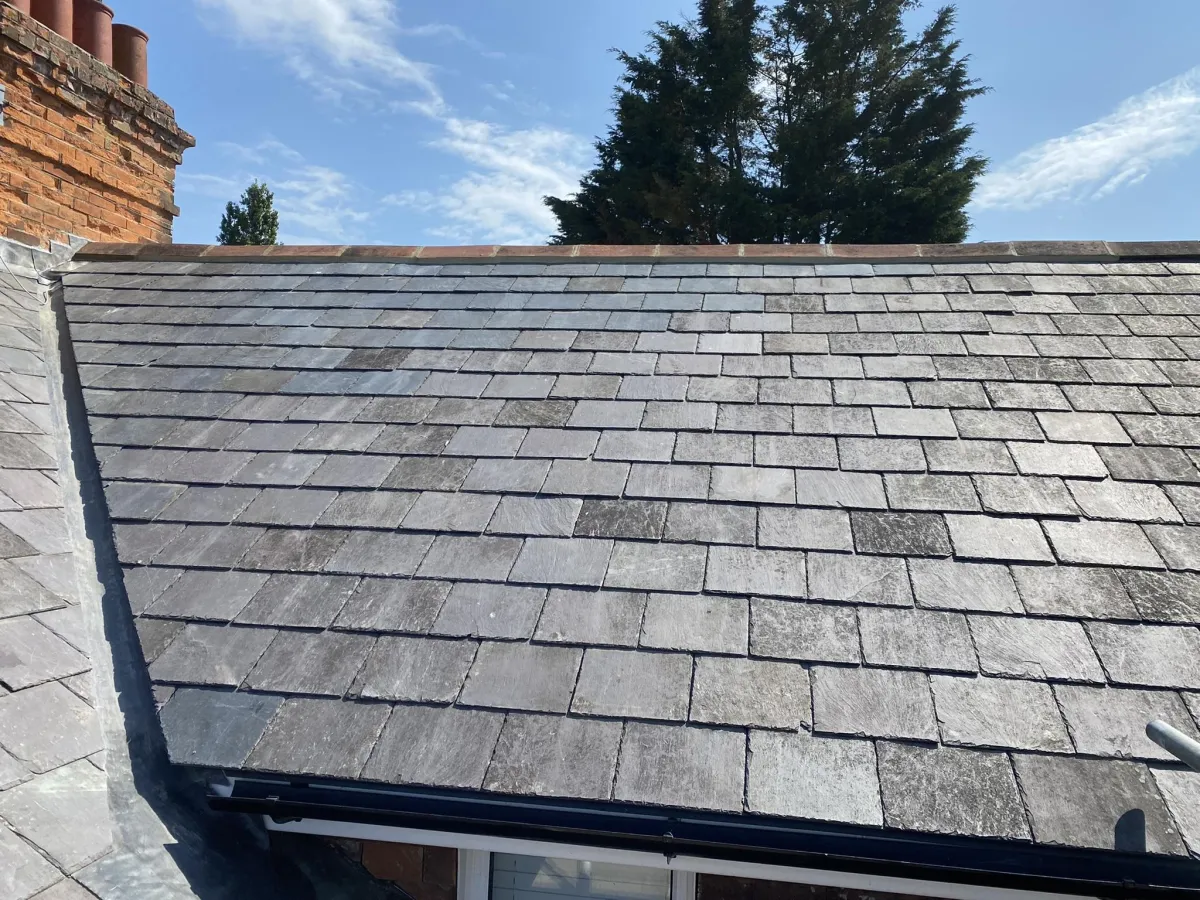
Cranbrook sits ten minutes from our Biddenden yard, and the town's roofscape is dominated by clay peg tiles on steep pitches, often on timber-framed or Wealden hall-house structures dating back centuries. That combination means a roofing job here is rarely a straightforward strip-and-recover.
Whether the job is a full re-roof, a repair after storm damage, or new flashings around a chimney, the starting point is always the same: establish what the existing structure can carry, and what the conservation area designation requires for the replacement covering.
Clay peg tiles and matching stock
Most older roofs around the town centre and out towards Sissinghurst use handmade or early machine-made clay peg tiles hung on riven oak or sawn softwood battens. New tiles from current production runs rarely match the weathered colour of a fifty-year-old roof slope, so on a partial repair we look first at whether salvaged tiles from a reputable reclamation source can be used on the visible elevations, keeping new stock for less prominent slopes.
Tile weight matters as much as appearance. Peg tiles are heavy, and where a roof has sagged or the battens have degraded, we check the rafters and purlins can still carry a like-for-like covering before ordering material, rather than assuming the original design load still applies after decades of movement.
Tunbridge Wells Borough Council and conservation area consent
Cranbrook falls under Tunbridge Wells Borough Council, and the town centre conservation area covers much of Stone Street, the High Street and the land around Union Mill. Re-roofing a house within the designated area with a different tile profile, colour or material is the kind of change that typically needs planning permission even where the house itself is unlisted, because roofscape is one of the features the conservation area appraisal specifically protects.
Listed buildings — and there are a good number of timber-framed examples in and around the town — need listed building consent for roof works in addition to any planning permission, covering details as specific as fixing method and ridge treatment. We flag this at quote stage rather than leaving a client to discover it once tiles are already on order.
Access and scaffold on a working town centre
Properties directly on Stone Street and the High Street often have little or no frontage for scaffold footings, and pavement licences or short road closures are sometimes needed to erect a scaffold safely without blocking pedestrian access outside shops. We plan this into the programme and liaise with the council on any necessary permissions before the scaffolders turn up.
Further out towards Angley Road and the newer estates, standard driveway access and garden space make scaffold erection more straightforward, and we can usually get a crew on site within days of survey given the short drive from Biddenden.
Leadwork and chimney detailing on period roofs
Chimneys on Cranbrook's older housing stock are frequently the weak point on an otherwise sound roof — cracked flaunching, perished lead soakers and step flashings that were never properly dressed into the brick joints are common findings once we get a ladder up. Code 4 or 5 lead, cut and dressed by hand rather than pre-formed trims, is the standard we use on these details because it lasts and it looks right on a period elevation.
Valleys on hipped and multi-gabled roofs — common on the larger farmhouses around the town — need the same attention: a valley that has been patched with mastic rather than properly re-leaded will fail again within a season or two, so we replace rather than patch where the underlying lead has already perished.
Timing repairs before winter
A slipped tile or a failed flashing on a Wealden roof rarely stays a small problem for long, because water tracking under peg tiles onto old sarking boards or exposed rafters can rot timber that is otherwise sound. We prioritise emergency repairs in Cranbrook given the short response time from our yard, and would rather carry out a temporary weatherproof fix and return for the full repair than leave a known leak over a wet week.
For planned re-roofing, autumn and spring give the most reliable working weather for stripping a roof back to bare rafters, since a summer heatwave can dry out old mortar bedding faster than the crew can safely work, and winter storms extend how long any temporary covering has to hold.
Common questions
Do I need planning permission to re-roof my house in Cranbrook?+
If your property is within the Cranbrook Conservation Area and you're changing the tile material, profile or colour, planning permission is usually required even for an unlisted house. A like-for-like re-cover in the same tile type is more likely to be permitted development, but this should always be checked with Tunbridge Wells Borough Council before ordering materials.
Can you match the existing peg tiles on a partial repair?+
We look at salvaged or reclaimed peg tiles first for visible elevations, since new production tiles rarely match decades of weathering. Less visible slopes can often take new stock without the mismatch being obvious from the street.
How quickly can you get to an emergency roof leak in Cranbrook?+
Cranbrook is around ten minutes from our Biddenden yard, so we can usually attend the same day for a genuine leak to make it weatherproof, with a full repair scheduled once the extent of damage is assessed.
Book a roof survey in Cranbrook
Free site visit, a written scope covering consent requirements, and an itemised quote before any tiles come off.