
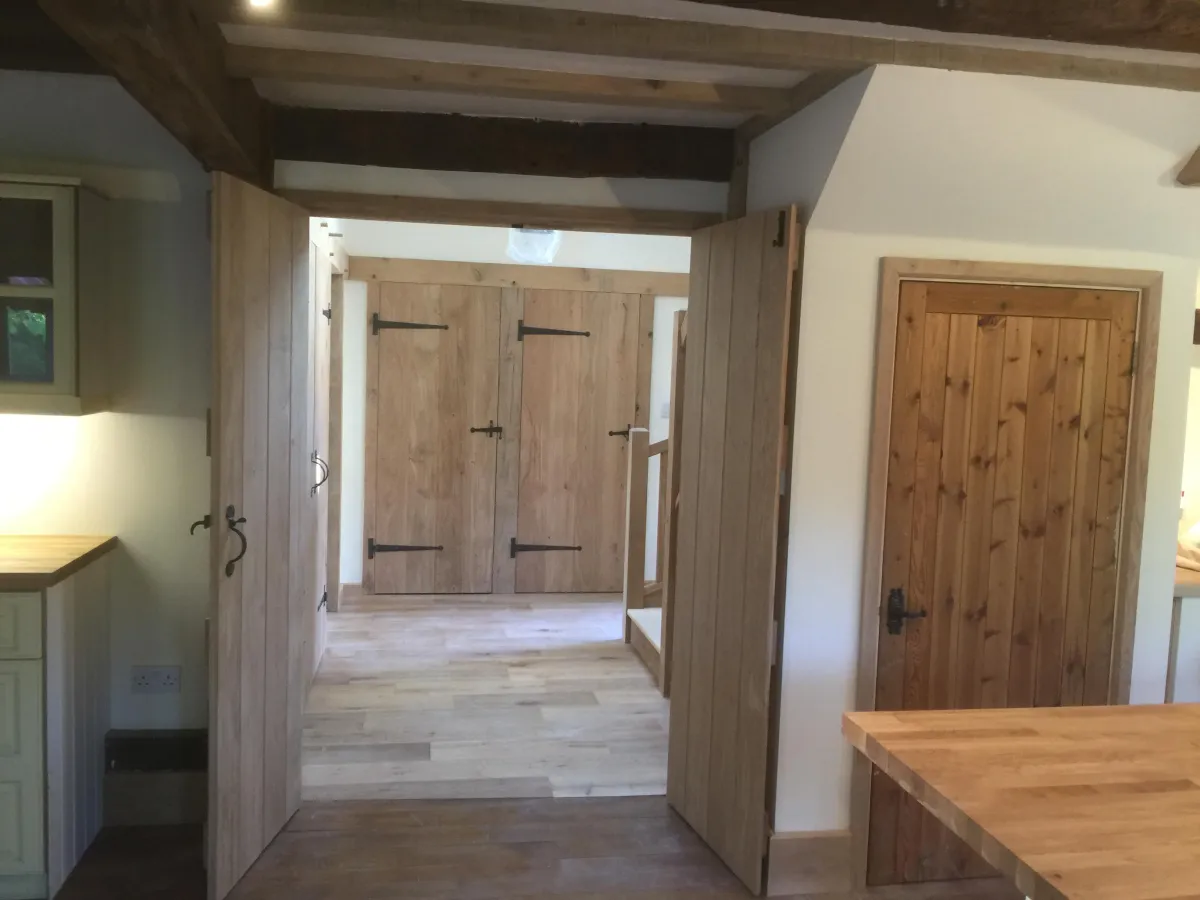
European oak is a dense, tannin-rich hardwood that has been the default structural and joinery timber across the Weald for centuries, and it still earns that reputation on the right job.
It isn't the automatic answer to every brief. Its weight, cost and chemical behaviour make it wrong for some applications where a cheaper, more stable material does the job better.
Where oak genuinely belongs
Exposed structural frames, feature staircases, entrance doors and any joinery item meant to be seen and touched for the next fifty years is where oak pays for itself. The grain and colour develop with age rather than degrading, and a well-detailed oak frame will outlast several redecorations of everything around it.
It also belongs anywhere a client wants a period-correct repair on a Wealden hall house or oast conversion, because matching new oak to old is far less jarring than introducing a different species into a historic frame.
Where it's the wrong material
Oak moves seasonally, more than most other structural timbers, so it's a poor choice for fitted furniture carcasses or anywhere a tight, unchanging tolerance matters — a wardrobe door in oak will bind or gap as the humidity in the room changes through the year.
It also reacts badly with standard steel fixings. The tannins in the wood corrode ferrous metal, and the corrosion in turn stains the timber black around every nail or screw head, so any fixing in or near oak has to be stainless or silicon bronze from the outset.
For fully hidden structural work — joists, studwork, roof carcassing that will never be seen — oak's cost and weight aren't justified, and kiln-dried softwood does the same structural job for less.
What we specify instead
For fitted furniture and kitchens where the oak look is wanted but the movement isn't acceptable, we specify engineered oak veneer over a stable core, which gives the same face appearance with a fraction of the seasonal shift.
For hidden carcassing and structural elements with no visual role, kiln-dried softwood or engineered sections do the job at a lower cost and with more predictable behaviour on site.
Substrate and structural preparation
Where oak is going into an existing opening — a replacement post, a repaired beam end, a new staircase against an older floor — the surrounding structure has to be checked and often packed level before the oak goes in, because oak sections are jointed to fine tolerances and won't take up a large discrepancy in an out-of-true opening the way a more forgiving material might.
Any masonry the oak will bear directly on needs a damp-proof membrane or bearing pad between the two, since oak held permanently against damp masonry decays from that point of contact outward even where the rest of the timber stays sound for decades.
Reading a written oak specification
A specification worth trusting names the timber's grade explicitly rather than describing it only as 'European oak', states the target moisture content, and lists the fixing metal by name rather than leaving it assumed.
It should also say who treats cut ends and drilled holes on site, because a length that arrived with sealed end grain and then has holes drilled into it during fitting has lost that protection at precisely the point most likely to take on water.
Common questions
Can oak be used outdoors without treatment?+
Green or air-dried oak can be left untreated outdoors and will silver over time, which is the traditional look for gates, cladding and exposed frame feet. Kiln-dried oak used internally should not be treated as an exterior product without re-specifying the moisture content and detailing.
Does oak need to be sealed or oiled?+
Internal oak joinery is usually left with a hardwax oil or left bare depending on the finish wanted; painting oak is unusual because it hides the point of choosing it. Exterior oak generally isn't painted at all — it's left to weather.
Why do the fixings matter so much with oak?+
Standard zinc or mild steel screws and nails will corrode within a few years of contact with oak's tannic acid, leaving black staining that can't be sanded out without removing a significant depth of timber. Every fixing specified against oak in our quotes is stainless steel or silicon bronze for this reason.
Ask us whether oak suits your project
We'll tell you plainly if oak is the right call for your job or if we'd specify something else, before you pay for a design that doesn't work.