
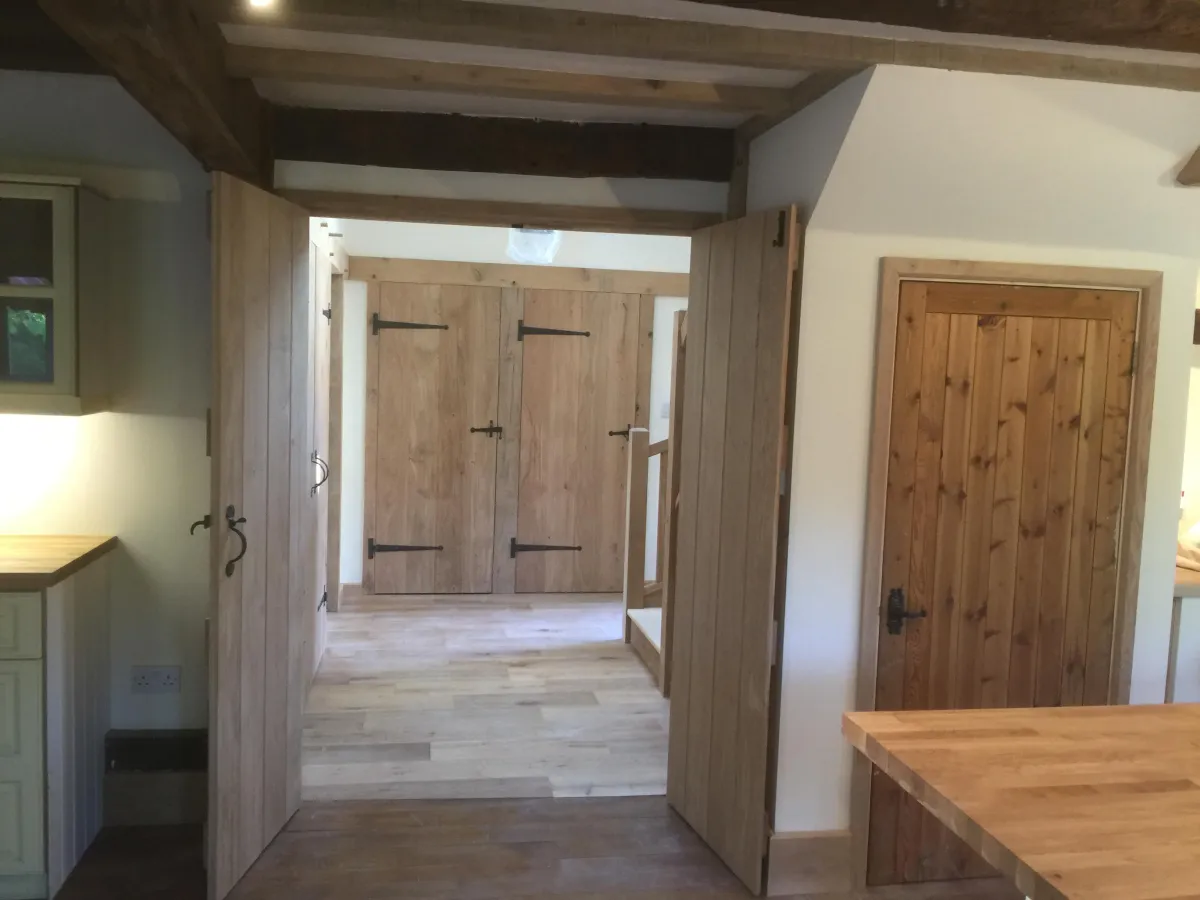
A fitted wardrobe door that used to swing cleanly starts catching at the bottom corner against the carcass, or the top edge scrapes the ceiling line as it opens. Because wardrobe doors are usually much taller than kitchen or cupboard doors, small amounts of sag show up much more obviously — the same drop in millimetres that's invisible on a kitchen door reads as a clear rub on a two-metre wardrobe door.
The height and weight of these doors also means the causes lean differently than they do in a kitchen: hinge rating and how the carcass is anchored to the building matter more than they do on smaller cabinetry.
What the pattern of rubbing tells you
A door that catches only at the bottom, on the hinge side or opposite it, usually means the whole door has dropped slightly on its hinges — classic sag under weight. A door that fouls the top or the ceiling line as it swings, rather than at the bottom, more often points to the carcass itself being out of square or having racked.
The likely causes
Tall doors sagging on undersized hinges is the most common cause. A door that's within the technical weight limit of its hinges on paper can still sag over years of daily use if the hinge count was minimal to begin with — two hinges on a very tall door rarely stays true for long.
Carcass racking is the next most likely, particularly where a wardrobe was only fixed to plasterboard rather than back to solid structure. Without a rigid fixing into studs or noggins, the whole carcass can twist very slightly under the leverage of a heavy door swinging on it, and that racking shows up as the door no longer meeting a square opening.
Ceiling or floor deflection is a less common cause but worth ruling out in older buildings, where a slight sag in the floor or ceiling above a fitted run can be enough to bring a tall door into contact with a surface that used to clear it.
Heavy mirrored doors on standard, non-upgraded hardware is a specific and fairly common cause on its own — the added weight of mirror glass over a standard MDF door face pushes ordinary hinges past what they're comfortable holding long-term.
How to check which one applies
- Count the hinges and compare against the manufacturer's rated weight for that hinge and the actual weight of the door, including mirror glass if fitted.
- Check whether the carcass is screwed into a stud or noggin behind the wall lining, or only into plasterboard — a fixing that only bites into plasterboard will not hold a heavy door rigid long-term.
- Use a spirit level or square to check whether the opening itself is square, rather than assuming the fault is only in the door and hinges.
- Note whether the rubbing is worse at one end of a run of wardrobes than another, which can point to a localised structural cause such as a joist deflection.
When it becomes a safety issue rather than a nuisance
A door that's mildly out of alignment is a comfort issue. A tall, heavy door — particularly a mirrored one — on hinges that are visibly failing or a carcass that's not properly fixed back to the structure is a different matter, because failing hinges under sustained load can let a door drop suddenly rather than gradually. If a door feels loose or unstable to the touch rather than just tight-fitting, it shouldn't be left as a minor cosmetic issue.
Common questions
Why do mirrored wardrobe doors sag more than plain ones?+
Mirror glass adds significant weight over a standard door panel, which puts more sustained load on the same hinges. Unless the hinge count and rating were specified for that extra weight from the outset, sag over time is common.
Is it the carcass or the door that's usually at fault?+
More often the carcass fixing than the door itself — a wardrobe that's only fixed to plasterboard, rather than back to studs or noggins, will flex under the weight of a swinging door regardless of how good the door and hinges are.
Can I add more hinges myself to fix sagging?+
You can, but if the carcass behind the hinge isn't fixed to solid structure, extra hinges alone won't stop the racking that's causing the problem — the carcass fixing needs addressing as well.
Arrange a free wardrobe inspection
We'll check hinge loading, carcass fixing and the opening itself, then quote in writing for whatever's actually needed.