
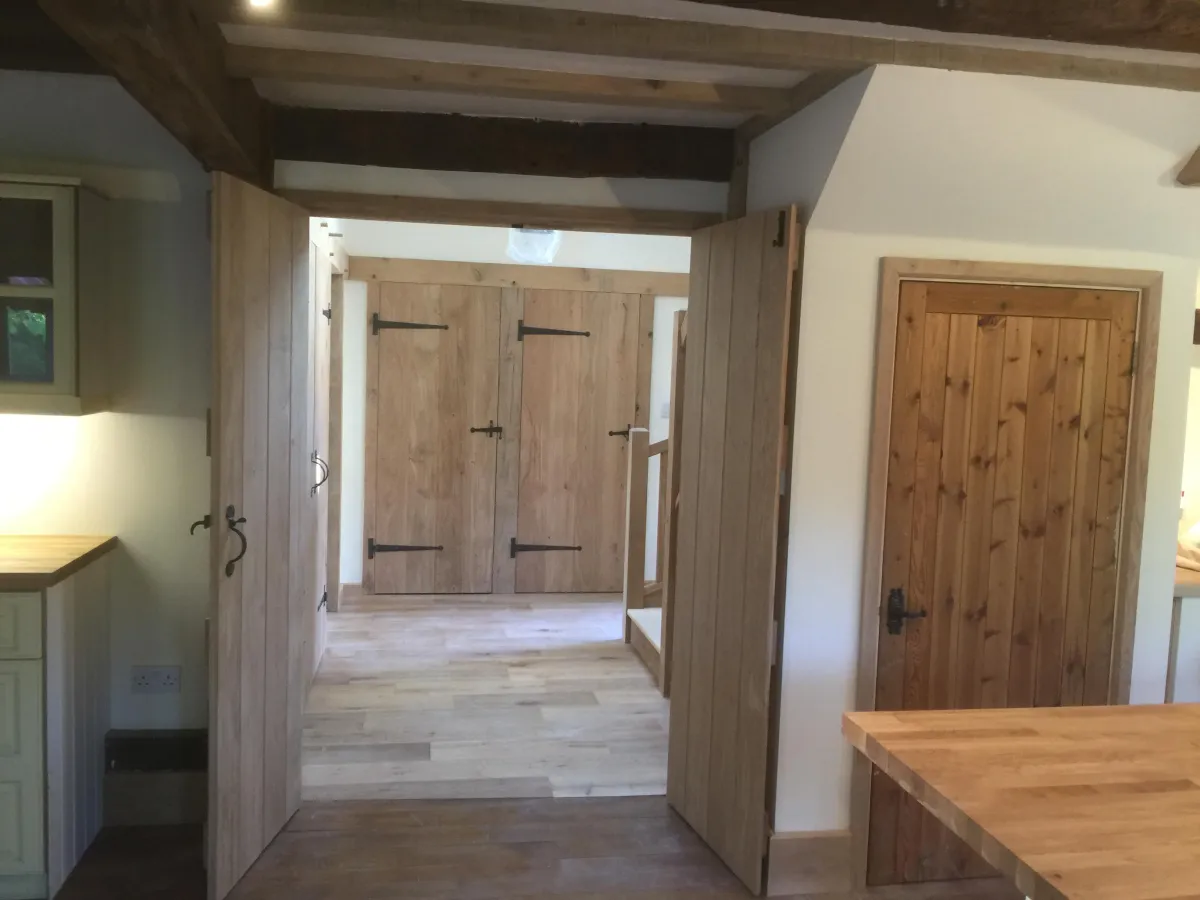
Solid and engineered wood flooring can look identical once fitted and finished, so the decision comes down to how each behaves underneath the surface rather than appearance.
The construction difference is the whole story: solid boards are one piece of timber through their full thickness, while engineered boards have a real wood wear layer bonded to a stable plywood or softwood core.
Dimensional stability
Solid timber expands and contracts across its width with seasonal humidity changes, which is why solid floors need expansion gaps at the perimeter and generally aren't recommended directly over underfloor heating, where the constant heat cycle can cause cupping or gapping.
Engineered boards move far less because the cross-layered core resists the seasonal shift that solid timber undergoes. This is why engineered is the standard specification over underfloor heating and in rooms where humidity varies, such as a kitchen-diner.
Refinishing over the years
A solid board can typically be sanded and refinished several times over its life, because the wear layer is the full thickness of the timber. This gives a genuinely long lifespan and the option to change the finish colour entirely at a later date.
An engineered board's wear layer is thinner, so it can be sanded fewer times — often once or twice depending on the veneer thickness — before the base layer becomes visible. This matters more in high-traffic areas that will need refinishing sooner.
Where each is suited
Solid boards suit first-floor rooms with stable humidity and no underfloor heating, where their longer refinishing life is a genuine long-term advantage.
Engineered boards suit ground floors, kitchens, rooms with underfloor heating, and any solid concrete subfloor, where dimensional stability and compatibility with the heating system matter more than maximum refinishing cycles.
Installation and subfloor
Solid boards are usually nailed or secretly fixed to a timber subfloor, which limits where they can go without additional structural work on a solid concrete floor.
Engineered boards can be fixed, floated or glued down depending on the product, which makes them far more adaptable to a solid concrete ground floor or a floor with underfloor heating cast into it.
Common questions
Is engineered flooring 'fake' wood?+
No — the visible wear layer is real timber, typically a few millimetres thick, bonded to a stable core. It looks and feels like solid wood underfoot and takes the same site finishes.
Can solid wood flooring ever go over underfloor heating?+
Some specific solid wood products and species are rated for underfloor heating with careful installation and moisture control, but it's the exception rather than the rule, and it needs checking against the manufacturer's specification before committing.
Which is better value over twenty years?+
Solid flooring on a stable first floor generally offers more refinishing life for the money over a very long period. Over underfloor heating or a concrete ground floor, engineered is the only sensible option regardless of long-term value, because solid boards risk failing there.
Get flooring advice for your project
Tell us your subfloor and heating setup and we'll recommend solid or engineered flooring with a written quote for supply and fitting.