
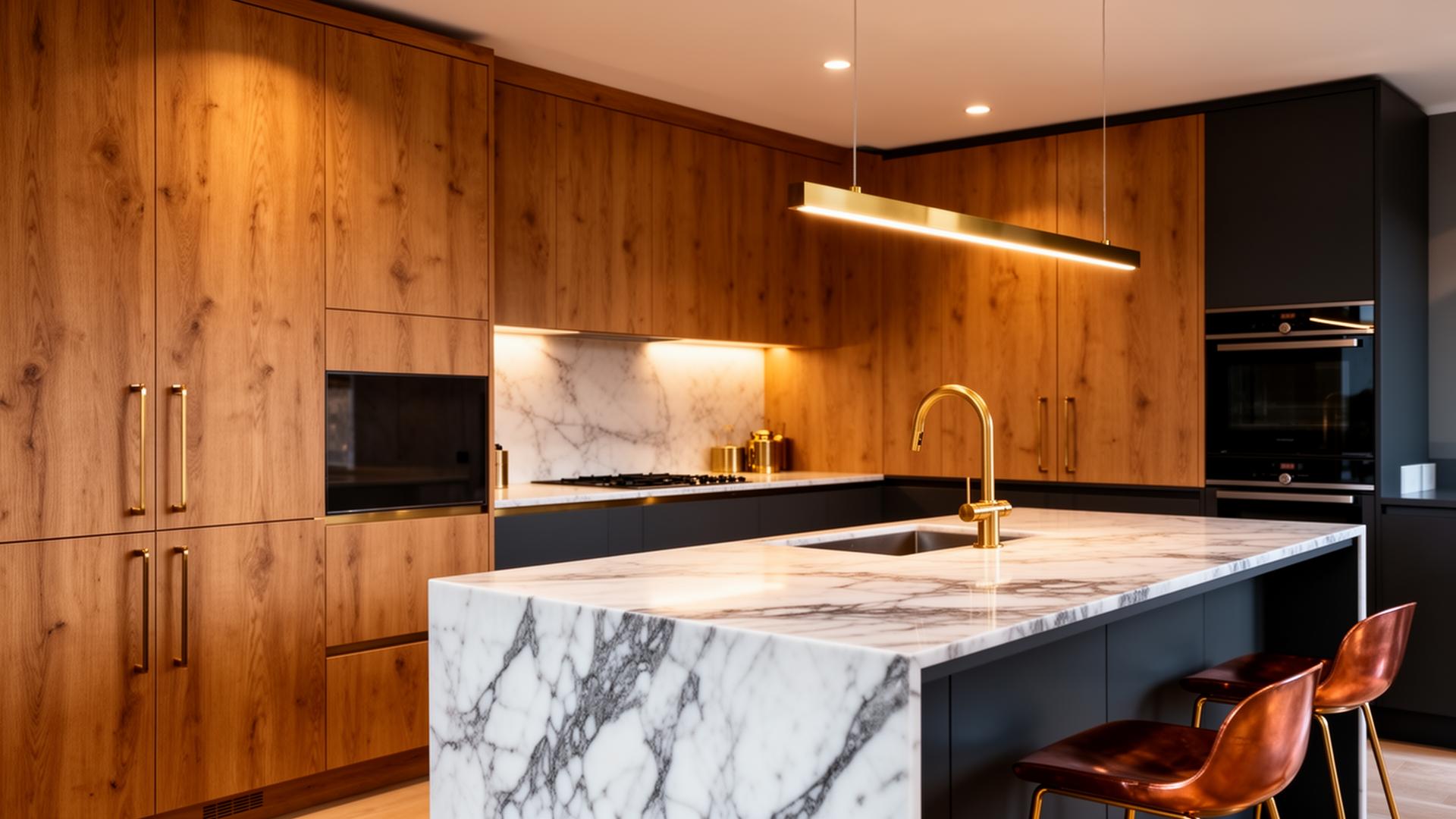
Solid timber worktops are made from strips of hardwood — oak, walnut and beech are common choices — glued edge to edge into staves and finished with a penetrating oil rather than a hard lacquer. Unlike an engineered board, the timber here is solid all the way through.
They suit a particular kind of kitchen and a particular kind of owner: one willing to keep up an oiling routine in exchange for a warm, repairable, genuinely natural surface.
How the top is built
Staves — narrow strips of timber, typically 40-60mm wide — are glued together under pressure so the whole top moves as evenly as possible across its width, rather than as one wide plank that would cup badly.
The top is left to move seasonally with humidity, so it's fixed to the cabinets with slotted brackets or clips that allow that movement, rather than being screwed rigidly, which would crack the timber.
Where it belongs
Cottage and shaker-style kitchens where a natural, warm finish matters more than absolute practicality are the classic fit, along with island tops used mainly for prep rather than as a wet zone.
Utility rooms suit timber well too — lower footfall for food prep, less risk of standing water, and the warmth of timber works better there than a cold stone surface.
Where it's the wrong call, and what we specify instead
A busy family kitchen where nobody has time for an oiling routine is a poor fit for solid timber — neglected timber worktops go grey and dry out, then need heavier remedial sanding than a maintained top ever would. We'd usually steer that brief towards quartz.
Directly around a sink, unless the detailing is done properly, timber is risky — standing water at a poorly sealed joint will swell and blacken the timber. We specify a fully sealed, slightly domed edge around sink cut-outs and, where a client is nervous about it, suggest a quartz or stainless run either side of the sink instead of timber right up to the bowl.
Grain orientation and how a stave top is oiled before fitting
Staves can be laid with the grain running the length of the run (the common choice) or edge-grain up, which shows the end grain of each stave as a narrow stripe and wears slightly better under a chopping board, though it costs more to produce.
A new solid timber top needs several coats of oil applied and left to soak in before it ever goes near food, including the underside and any cut edges around a sink or hob, since an unsealed edge is where water gets in first. We oil the top again once fitted, after any final on-site trimming has exposed fresh, unsealed timber.
Common questions
Which timber is best for a worktop?+
Oak is the most common choice for its hardness and appearance; walnut is softer and darker with a different character; beech is a paler, tighter-grained option. The right choice depends on the kitchen's look and how heavily the top will be used.
Can solid timber go next to a hob?+
Yes, with a heat-resistant upstand or gap specified at design stage, but pans should still never be set directly on the timber — the same rule applies as with most worktop materials.
Is timber hygienic for food prep?+
Yes when properly oiled and dried after use — the oil finish limits bacterial penetration into the wood. Standing water and neglect are what cause problems, not the material itself.
Discuss solid timber worktops for your kitchen
We'll talk through whether solid timber suits how your kitchen is actually used before you commit to it over a lower-maintenance alternative.