
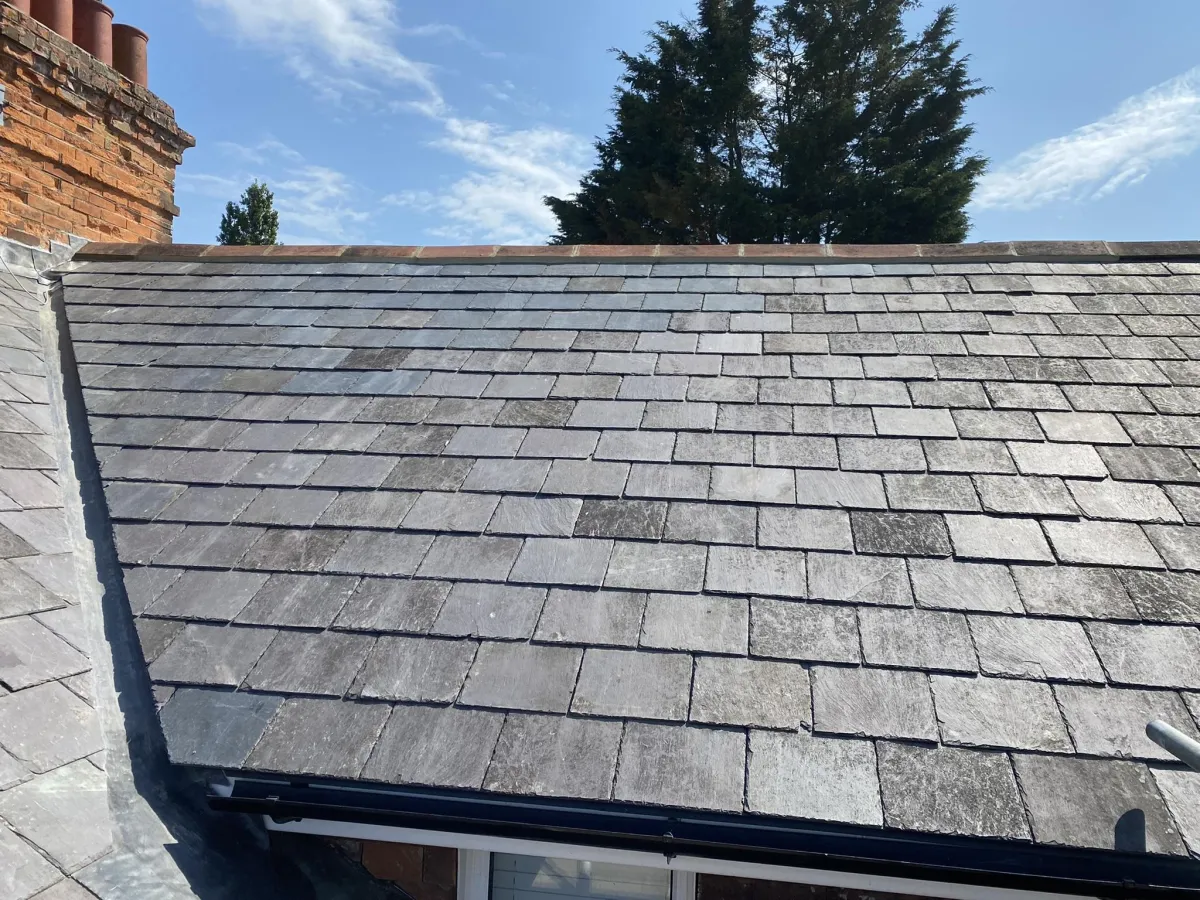
Clay peg tiles have one of the longest service lives of any common roof covering when properly fixed and maintained, and their key practical advantage is that individual tiles can be replaced without disturbing the rest of the roof.
The ageing pattern is different from a covering like felt or bitumen shingle, where the whole system degrades together — a clay peg tile roof tends to fail tile by tile over many decades, which makes ongoing, low-level maintenance the right approach rather than waiting for a full re-cover.
Normal ageing
Individual tiles weather and can develop surface lamination or frost damage over many decades, particularly handmade tiles from older firings, without this indicating a problem with the roof as a whole.
Battens and the pegs or nails holding tiles in place have a shorter life than the clay itself, and battens in particular are often the actual point of failure on an older roof, even when the tiles look sound.
Maintenance regime
A periodic visual inspection, ideally from the ground or via a proper access platform rather than by walking the roof, should look for slipped, cracked or missing tiles, particularly after high winds.
Roof access for inspection or repair on a pitched clay tile roof needs proper scaffolding or a tower — this isn't a roof for a homeowner to walk on with a ladder, both for personal safety and because clay tiles are easily cracked underfoot.
Gutters and valleys should be kept clear, since debris trapped against the tail of a clay tile holds moisture against it and speeds up frost damage over winter.
Early warning signs
A slipped tile leaving a gap, visible from the ground as a dark patch in an otherwise even roof plane, is the most common early sign and should be addressed before water gets into the batten and rafter beneath it.
Powdery, flaking tile surfaces or tiles that sound hollow when gently tapped indicate frost damage working through the clay, usually starting on the most exposed slope of the roof.
Sagging along a roof plane, as opposed to individual tile issues, points to batten or rafter failure underneath and needs a proper roof inspection rather than a simple tile swap.
Repair versus re-cover
Individual slipped or cracked tiles can be replaced one at a time, which is the main practical advantage of the material — this can go on for decades as isolated tiles fail without needing to touch the rest of the roof.
Widespread tile failure across a slope, or batten and felt failure discovered underneath a run of tiles, is a sign the roof needs stripping and re-covering on that section rather than continuing with spot repairs, since the underlying structure is what's actually failed.
Common questions
How long do clay peg tiles last?+
The clay itself can last upwards of a century in good conditions, though individual tiles fail and are replaced along the way. Battens and fixings typically need attention well before the tiles themselves do.
Can I walk on my clay tile roof to check it myself?+
No — walking a clay tile roof risks cracking sound tiles and is a fall risk. Inspection should be done from the ground, from a neighbouring vantage point, or via proper scaffold access.
How do I know if it's a few tiles or a bigger roof problem?+
A handful of slipped or cracked tiles scattered across the roof is normal wear. Sagging, damp patches inside the loft, or several tiles failing in the same area at once suggests a batten or structural issue that needs a full inspection.
Get your clay tile roof inspected
We carry out proper access-based roof inspections and can tell you honestly whether you need a few tiles replaced or a section re-covered.