
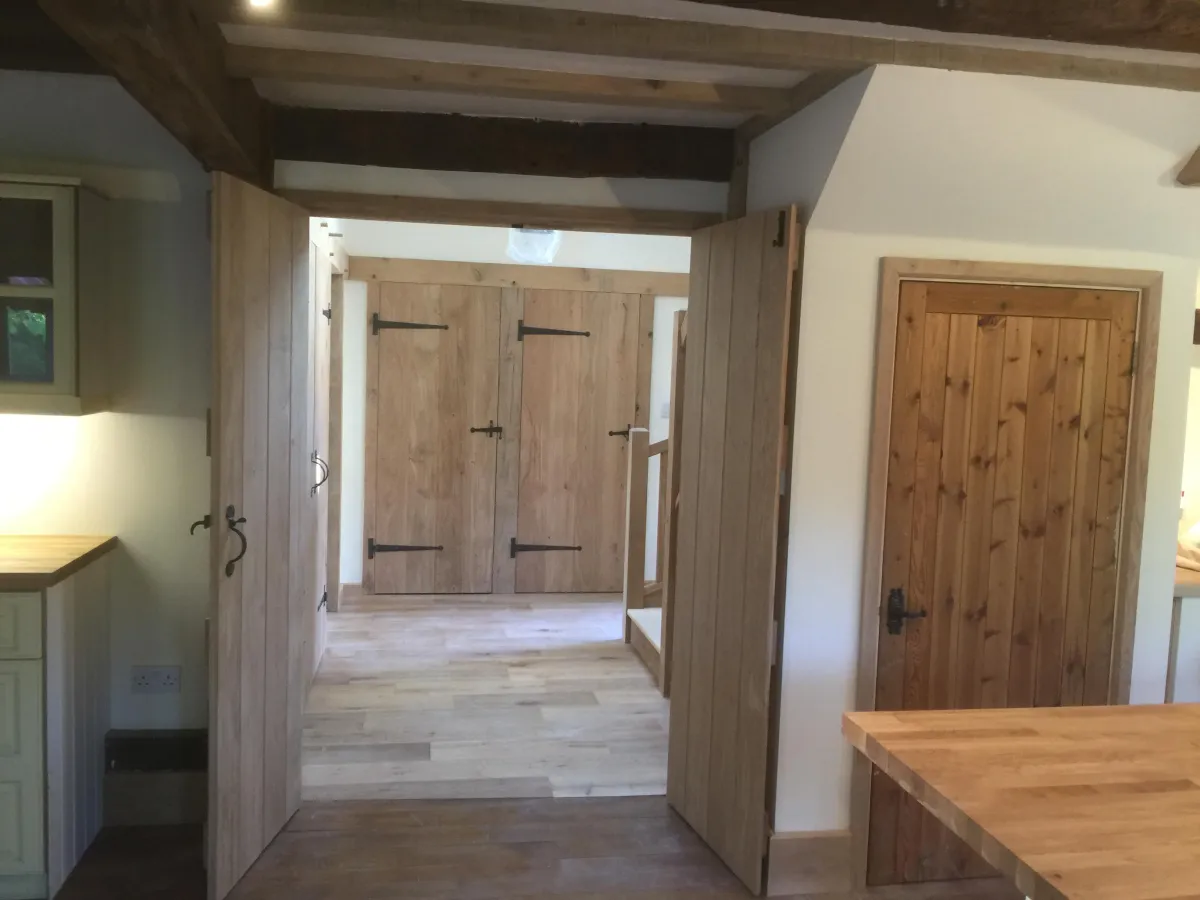
Well-detailed oak, whether it's a staircase, an entrance door or an exposed frame, is one of the longest-lived materials in domestic building work, and the maintenance burden over its life is genuinely low compared with painted softwood.
That longevity depends on a small number of checks being done occasionally rather than left indefinitely, because the failure modes in oak are slow but not invisible.
The first few years
New oak continues to lose moisture and move for a year or two after installation even when it arrived kiln-dried, so small gaps opening at mortise-and-tenon joints or panel edges in the first couple of winters are normal rather than a defect.
Any surface checking — fine splits along the grain on exposed beam faces — is cosmetic in most cases and doesn't affect structural performance, though it should be checked against the depth of the section if the beam is load-bearing.
The maintenance regime
Internally oiled oak benefits from a fresh coat of hardwax oil every few years on high-wear surfaces like stair treads and door edges, applied after a light abrasion rather than a full strip back.
Externally, oak left to weather naturally needs nothing beyond keeping end grain and ground contact points clear of standing water, since end grain absorbs moisture far faster than the face grain and is where rot starts.
Fixings should be inspected periodically wherever they sit in or near the timber — any streaking black stain radiating from a screw head is a sign the wrong metal was used and it should be swapped out before the corrosion spreads further into the grain.
Warning signs that mean repair, not just watching
A joint that has opened enough to let light through, or a beam that has developed a soft, spongy patch rather than a hard surface check, has moved from cosmetic movement into something that needs a joiner's assessment.
Any oak in ground contact or close to a damp source that shows dark, crumbling decay rather than the expected silvering needs a specialist look, because rot in oak can travel further under the surface than it appears externally.
How oak moves through the seasons
Oak's moisture content shifts with the ambient humidity in a room or the weather outdoors, and that shift shows up as small dimensional changes across the grain — a door that closes with slight resistance in a damp winter and swings free again by summer is oak behaving normally, not a fault to correct by planing it down.
Planing an oak door to fit a tight winter gap often leaves it rattling loose once the timber dries back out in summer, so any adjustment to a moving oak item is best made only after watching it through a full seasonal cycle rather than reacting to a single snapshot.
What a maintenance quote should state
A written maintenance visit for oak should say explicitly which items are being checked — fixings, end grain, ground contact points, joint movement — rather than a general 'inspection', since oak's failure points are specific and a vague inspection can miss the one that matters.
It's also worth having the finish product named if any oiling or resealing is included, because mixing oil products with different bases over successive maintenance visits can leave a patchy, uneven sheen across the same piece.
Common questions
Will oak joinery need replacing eventually?+
Properly detailed oak, kept clear of standing water and fitted with the right fixings, commonly outlasts every other component in a building. Replacement is rarely about the timber failing and almost always about localised damage at a specific point of water ingress.
Is it normal for an oak staircase to creak more with age?+
A small increase in creaking as joints season and settle over the first year or two is normal. A sudden change in creaking on an older staircase, or visible movement in a tread, is worth having looked at rather than ignored.
How do I know if a repair is enough or the whole piece needs replacing?+
If the decay or damage is localised — a rotten post foot, a single split tread — a scarfed or spliced repair in matching oak is usually possible and is what we'd specify first. Replacement is reserved for pieces where the damage is widespread or the structural section has been compromised.
Get an oak joinery inspection
If you're not sure whether ageing oak needs a repair or just watching, we'll take a look on a free site visit and tell you straight.