
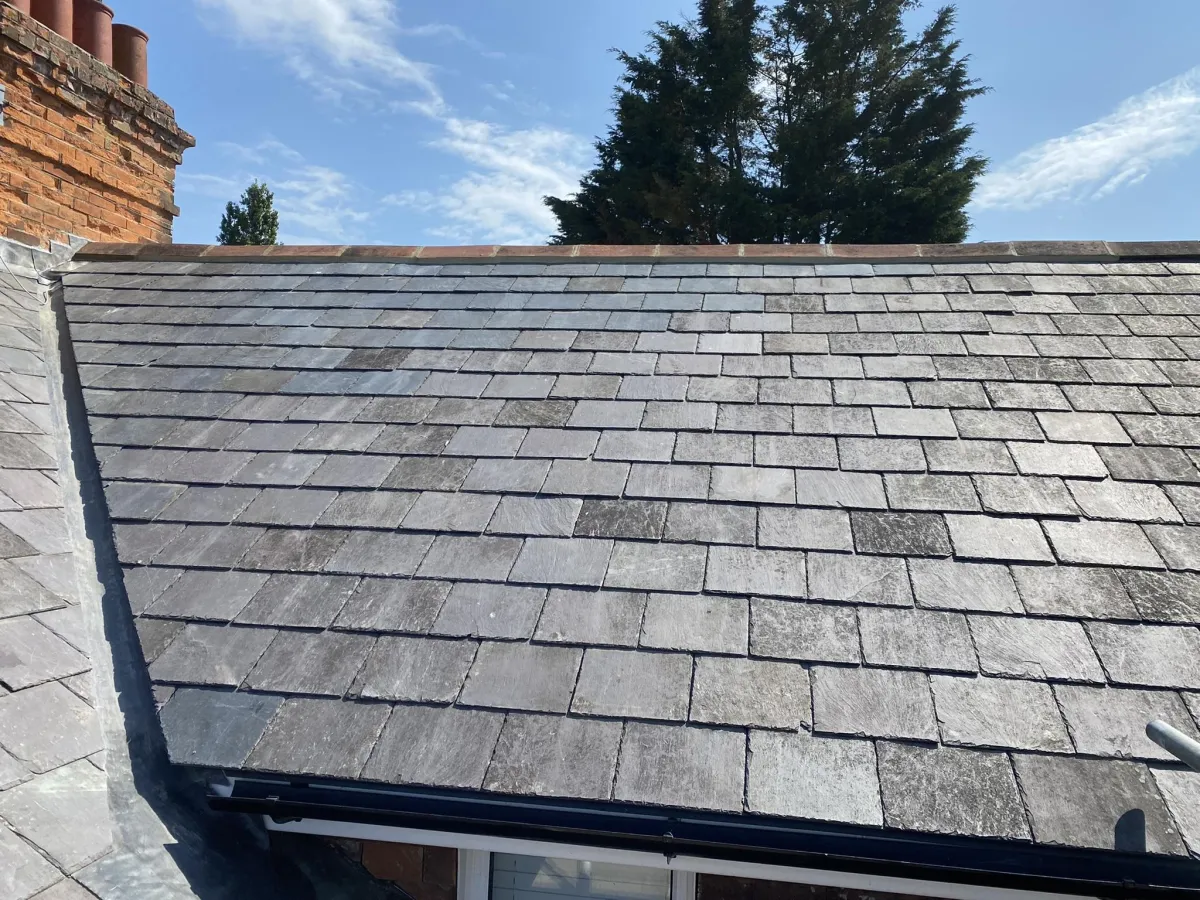
The water usually shows up somewhere other than the point of entry, which is why the first repair attempt often misses. Water runs down a rafter or along the top of a ceiling before it drops, so a stain a metre inside the room can come from the wall junction.
The four details that fail
A missing or badly formed cavity tray is the most serious. Where a new roof abuts a cavity wall, a tray must be built into that wall to catch water running down the cavity and throw it out through weep holes above the flashing. Retro fitting one means cutting the wall in short sections, so it gets skipped and the leak is blamed on the lead.
Then there is the lead itself. A cover flashing needs to be chased at least twenty five millimetres into a bed joint, wedged and pointed, and lapped over an upstand. Lead dressed onto the face of the brickwork and sealed with mastic will pass water within a couple of winters as the sealant shrinks.
- No cavity tray, or a tray with no weep holes
- Flashing chased too shallow, or bonded with mastic only
- Lead sheets run in lengths that are too long, so thermal movement splits them
- Upstand height under the recommended one hundred and fifty millimetres on a flat roof
Flat roofs and pitched roofs fail differently
On a flat extension roof, the usual failure is the upstand. The waterproof layer needs to turn up the wall well clear of anything that might pond or of driven rain running down the brickwork, and be tucked behind a proper flashing. A short upstand looks fine on a dry day and lets go in a storm from the south west.
On a pitched extension roof, the failures cluster around the soakers and the step flashing at the sloping abutment, and at the bottom corner where the roof meets the wall and the gutter. That corner takes the concentrated run off from the whole roof plane and any gap there will show inside quickly.
How we trace it
We start dry and look at the detail from a ladder or a tower: chase depth, pointing, lead laps, weep holes, upstand height and whether there is any sign that a tray exists. Then we hose test in stages, starting low and working up, giving each stage twenty minutes so we know which zone lets water in rather than soaking everything at once.
Inside, the run of the stain along a rafter or a ceiling joist tells us the direction the water travelled, which narrows down the entry point on the elevation above.
The proper repair
Where the flashing is at fault, the repair is to strip the lead, cut a fresh chase in a mortar joint, dress new code four or code five lead in sensible lengths, wedge it and repoint. Where the cavity tray is missing, the wall is cut in short lengths above the roof line, trays and weeps installed, and the flashing rebuilt over the top.
Sealant, tape and liquid rubber patches over a bad detail buy a season. We would rather do the lead work once and correctly, which is the kind of job forty years on the tools makes fast rather than fiddly.
Want a professional to handle it?
Free site visit, fixed-price written quote and a 5 year workmanship guarantee — backed by 40+ years on the tools and our workshop in Biddenden.
"We had our loft insulated and boarded. From start to finish the process was smooth, professional and stress-free. Malcolm upgraded the insulation and …"
Common questions
Why does my extension only leak in heavy or wind driven rain?
That points to a detail that works under normal run off but is overwhelmed when water is driven up under a lap or across a short upstand. Missing cavity trays behave exactly this way.
Can the leak be fixed without disturbing the roof covering?
Often yes. Most abutment repairs are wall side work: new chase, new lead, repointing, and weep holes. Cavity tray retro fitting also happens from the wall rather than the roof.
Is mastic ever an acceptable repair?
As a temporary measure to get through a wet week, yes. As the permanent seal on a flashing, no. It shrinks, it hardens and it fails, usually within two or three years.
The extension is under warranty. Who should pay?
If the roof was built within the last few years, the original builder is normally responsible for a defective abutment. We are happy to write up what we find so you have something clear to put to them.
How long does the repair take?
A typical abutment strip and relead on a single storey extension is one to two days. Adding retro fitted cavity trays takes it to around three, because the wall is cut in short sections and each is left to set.