
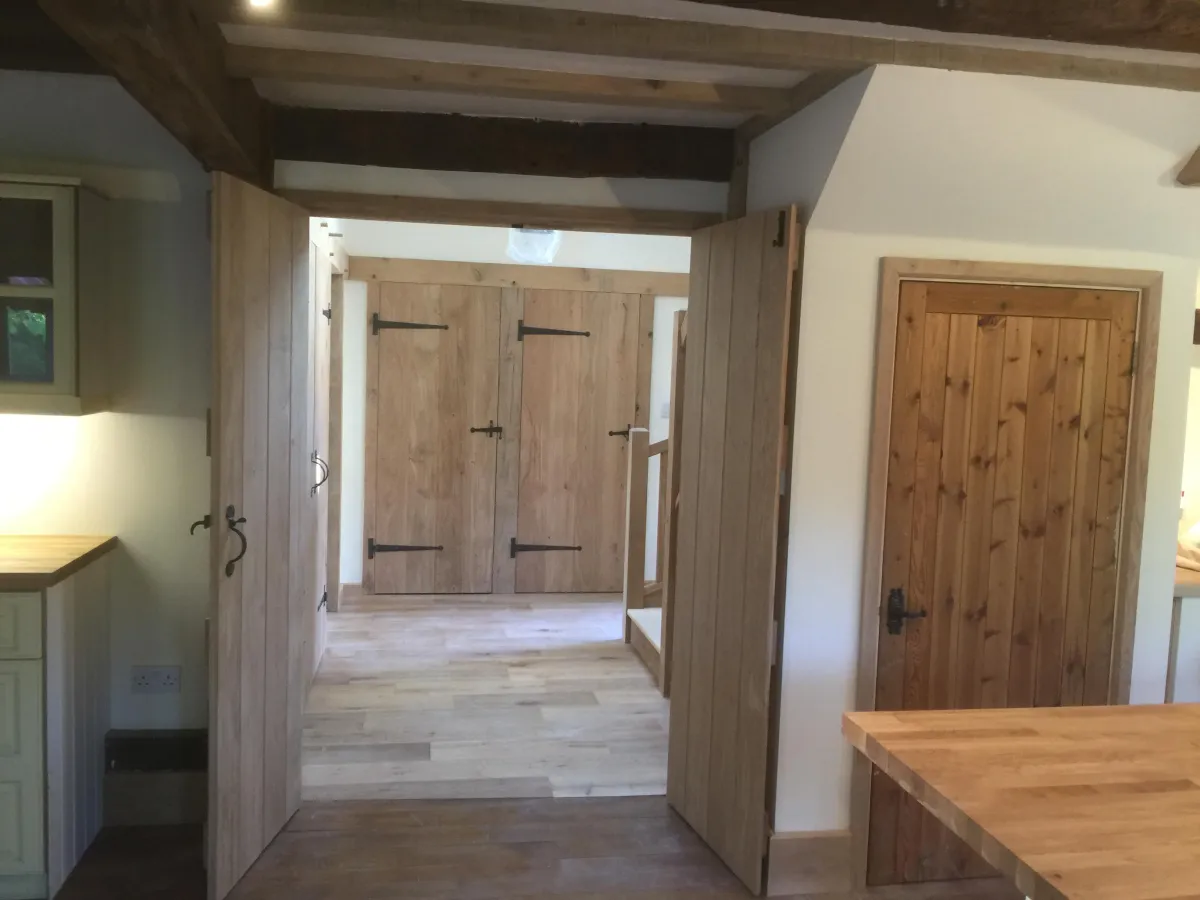
Engineered oak veneer board is a manufactured panel — usually an MDF, plywood or blockboard core — faced on both sides with a thin layer of real oak. The core does the work of staying flat and square; the veneer supplies the timber look.
It gets specified a lot on joinery jobs in Kent because it solves a problem solid oak creates on its own: wide boards move with humidity, and a wardrobe door or panelled end that's 600mm or more across will cup or bow if it's cut from a single solid plank.
What's actually in the board
The core is engineered timber product chosen for dimensional stability — moisture-resistant MDF is common for painted or lightly finished work, while a good plywood core suits pieces that will see more handling or structural load.
The veneer itself is sliced oak, typically laid as a balanced construction with a matching veneer on the reverse face. That balancing layer stops the board bowing towards the exposed side as it equalises with the room's humidity.
Veneer thickness varies by supplier, and it matters more than most people realise — a thin veneer looks identical on day one but limits every future decision about the board.
Where it belongs
Wide door fronts, wardrobe end panels, tall pantry doors and full-height panelling are the classic uses. Anywhere a single wide, flat, stable surface is wanted, engineered veneer outperforms solid timber.
It also suits situations where matched grain across several doors matters — veneer can be cut sequentially from the same log (slip-matched or book-matched) so a run of wardrobe doors reads as one continuous piece of timber, which solid boards rarely achieve economically.
Where it's the wrong call, and what we specify instead
Anywhere the edge of the board will be exposed and handled — a worktop edge, a stair nosing, an open shelf end that gets knocked — veneer is the wrong material. The face layer is too thin to shape, round over or repeatedly refinish, and a knock through to the core is very hard to hide.
For those situations we specify solid oak lipping glued to the exposed edge of the veneered panel, or move to solid timber entirely if the piece will take real wear. On worktops specifically we'll usually point a client towards solid timber or quartz rather than veneer, which was never designed for that use.
We also avoid veneer in rooms with sustained high moisture — next to a shower upstand, for example — because water finding its way under a chipped edge will delaminate the veneer from the core faster than it would damage a solid board.
How veneer joinery is put together on site
Sheets typically arrive from the joinery workshop already pressed, cut to size and edge-lipped, since veneer pressing needs controlled heat and pressure that isn't practical on a domestic site. Our job on site is fitting the finished panels — scribing end panels to a wall, hanging doors and setting hinge positions.
Because the veneer face can't tolerate rough handling, panels are wrapped and carried flat rather than stacked on edge, and any final cutting for services or fixings is done with a fine-tooth blade and a scoring pass to stop the veneer chipping along the cut line.
Common questions
Can engineered oak veneer be sanded and refinished?+
Lightly, yes — a light denib and re-oil is fine. A full sand-back is risky because the veneer layer is thin, and sanding through it exposes the core, which cannot be repaired invisibly.
Does veneer look obviously different from solid oak?+
Not to the eye once fitted and finished. The difference shows up at the edges and over decades of wear, not in day-to-day appearance.
Is engineered veneer cheaper than solid oak?+
Generally, yes, particularly on wide panels, because it avoids the wastage and movement allowance solid boards require. We'll set out both options with reasons on a written quote rather than defaulting to one.
Ask about engineered oak veneer for your joinery
We'll tell you honestly whether veneer or solid oak suits your doors, panels or storage, based on how they'll actually be used.