
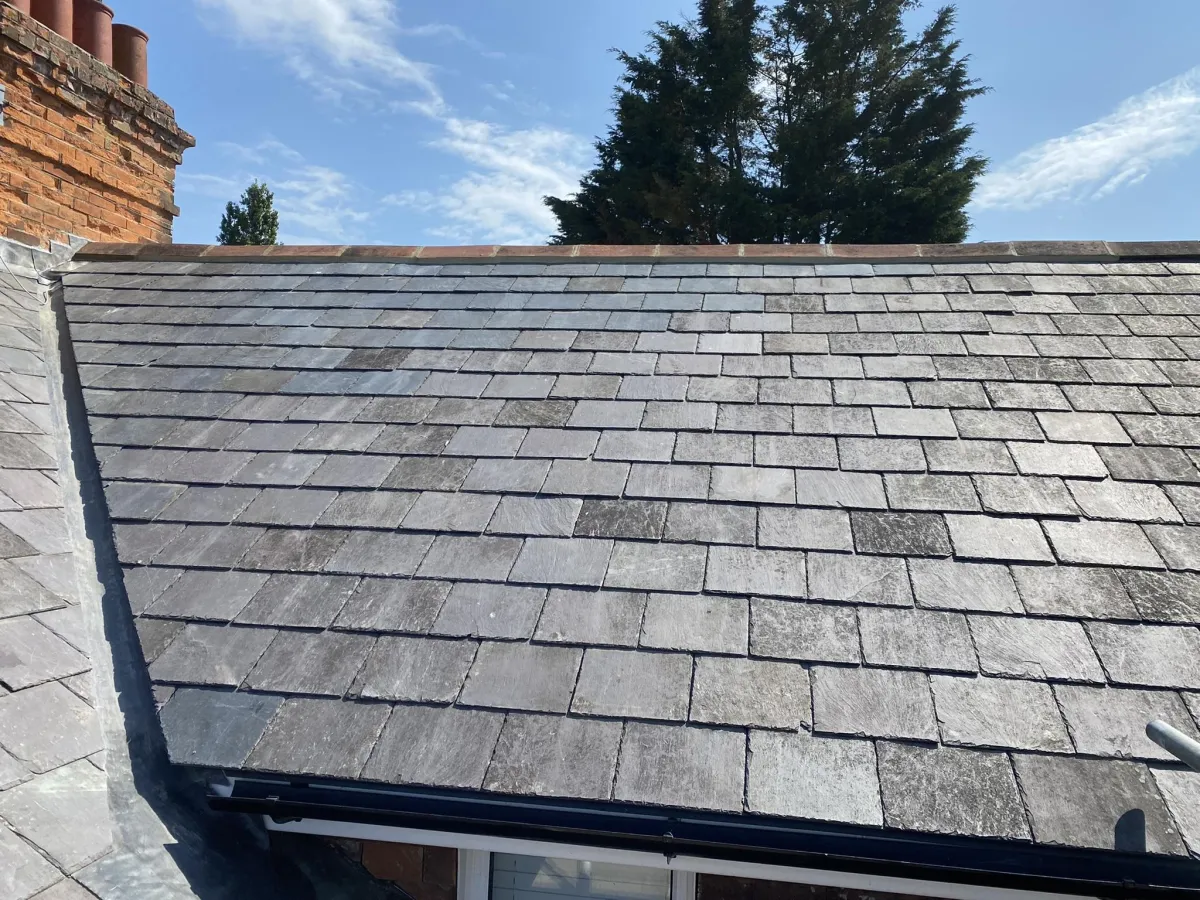
Kent has a distinctive roofscape: clay peg tiles on older cottages and farmhouses, plain clay tiles on Victorian and Edwardian terraces, natural slate on some period properties, and concrete interlocking tiles on post-war estates. Each comes with a different price per square metre and different considerations for matching existing work, particularly in conservation areas across the Weald where the roof covering itself can be a planning consideration.
Tile and slate choice: the biggest material variable
Concrete interlocking tiles are the most affordable roofing material and are what most 1960s–90s estate housing already has. Plain clay tiles cost more per square metre and are the standard covering on Victorian and Edwardian terraces across Kent's towns. Handmade clay peg tiles, used on many older Wealden cottages and farmhouses, are more expensive again and need a slower, more skilled fixing method.
Natural slate sits at the premium end. Where a roof is in a conservation area or on a listed building, the council may require like-for-like replacement in the original material, which removes the option of switching to a cheaper covering even if the budget is tight.
- Concrete interlocking tiles — most affordable, common on post-war estates
- Plain clay tiles — mid-range, typical on Victorian and Edwardian terraces
- Handmade clay peg tiles — premium, traditional on Wealden cottages and farmhouses
- Natural slate — premium, often required for listed or conservation area properties
Scaffolding: unavoidable and often underestimated
You can't safely re-roof a house without full scaffolding around it, and on anything but a small single-storey building that's a significant cost before a single tile is touched. Scaffolding cost depends on the roof's height, the complexity of the elevations (dormers, bay windows and chimneys all add scaffold lifts and returns), and how long it needs to stay up.
Because scaffolding is a largely fixed cost regardless of roof size, it's often worth doing other exterior work — fascias, soffits, guttering, chimney repointing — while the scaffold is up rather than paying for it twice a few years apart.
What's underneath the tiles matters as much as the tiles
Stripping the roof covering off exposes the roofing felt (or lack of it on older roofs), the battens, and the rafters and purlins themselves. Many roofs on older Kent properties still have old bitumen felt that's failed, no breathable membrane, and battens that are undersized by modern standards. Replacing these properly as part of the re-roof is standard practice and priced into a full re-roof quote, but it's a step some cheaper quotes skip by re-using old battens or omitting a proper breathable membrane.
Rafter and purlin timber decay, particularly around chimneys and valleys where water has been getting in for years before it showed up as a leak indoors, is the most common unexpected cost on a re-roof. We flag suspect areas at quote stage where we can see them, but some decay is only found once the tiles are off.
Roof shape, valleys and detailing
A simple pitched roof with two plain slopes is the cheapest shape to re-cover. Valleys, hips, dormers, chimneys and roof windows all add labour because each junction needs lead flashing or a valley system cut and dressed by hand, and each is a potential future leak point if not detailed properly.
Older Wealden farmhouses and oast-adjacent buildings often have complex roofscapes with multiple pitches and valleys, which is part of their character but does mean more detailing work per square metre of roof than a simple estate house.
Insulation and warm roof upgrades
A re-roof is the obvious moment to improve insulation, either at ceiling level (cold roof) or between and over the rafters (warm roof), particularly if the loft space is used or a conversion is planned later. Warm roof upgrades add cost at re-roofing time but are far cheaper than doing them as a separate job later, since the roof covering is already off.
Access and site conditions specific to Kent
Farmhouses and cottages down narrow Wealden lanes, properties with no side access for a scaffold lorry, and roofs close to boundaries with neighbouring properties all add time and cost that a straightforward estate house with a driveway doesn't carry. It's worth flagging access constraints when you first ask for a quote so the price reflects reality rather than being revised once a scaffold team turns up and can't get a lorry down the lane.
Common questions
Do I need planning permission to re-roof my house?
A like-for-like re-roof usually doesn't need planning permission. It can if you're in a conservation area and changing the tile type or colour, or if the property is listed, where the council typically requires matching the existing material exactly.
How long does a full re-roof take?
A straightforward pitched roof on an average semi typically takes one to two weeks including scaffolding, strip-out, felt and batten renewal, and re-covering. Complex roofs with multiple valleys, dormers or chimneys take longer.
Can I just repair the roof instead of replacing it fully?
If the failure is localised — a cracked valley, a handful of slipped tiles, a flashing detail — a repair is the sensible route and we'll always recommend it over a full re-roof where it genuinely solves the problem. Widespread tile failure, felt breaking down across the whole roof, or repeated leaks in different spots usually mean repairs are becoming false economy.
Is it worth adding insulation while the roof is being replaced?
Generally yes, because the roof covering being off is the cheapest opportunity you'll get to improve insulation, particularly if you might convert the loft in future or the current insulation is old and thin.
Why do two roofers quote such different prices for the same roof?
Usually because one has included full felt and batten replacement, a breathable membrane, and lead detailing to current standards, and the other has priced re-using existing battens and doing minimal work beneath the tiles. It's worth asking both what's included beneath the covering, not just the tile price.