
You feel it before you hear it, most of the time: a slight give under a tread, then the creak as timber surfaces rub against each other where they're no longer held tightly together. On some staircases it's one or two treads; on others the whole flight has a noticeable bounce to it when you cross the middle of a run.
Staircases are built from a lot of separate timber components — treads, risers, strings, wedges, glue blocks — all relying on tight joints to work as one rigid structure. Creaking and bounce both mean something in that assembly has loosened, and the causes range from completely routine to something that needs a proper look.
What the symptom actually tells you
A creak localised to one or two treads, especially near the nosing where you put your weight down first, usually points to a specific joint failure at that tread. A creak that seems to move around, or a flight that visibly deflects across its whole width, points to something affecting the structure more generally rather than a single joint.
Bounce is a slightly different signal from creak — you can have one without the other. Bounce without much noise often means the carriage or supporting structure underneath is flexing, whereas noise without much movement usually means two dry timber surfaces are simply rubbing.
The likely causes, in order of how often we find them
Dried and loosened wedges in the string housings are the most common cause on traditional cut or closed-string staircases. The wedges that lock each tread and riser into the string shrink slightly over years, especially in centrally heated houses, and the joint starts to work under load.
Glue blocks — the small triangular blocks glued underneath where tread meets riser — fall away with age as the glue fails. They add stiffness rather than strength, so their loss shows up first as noise rather than danger.
A missing or failed fixing at the top newel post is less common but more significant, because the newel often ties the top of the string and the landing structure together. Movement here can make the whole top of the flight feel slightly loose.
An undersized carriage — the additional timber run underneath a wide flight to stop it flexing in the middle — is the least common cause but explains genuine springiness across a wide staircase rather than noise from individual treads.
How to narrow it down
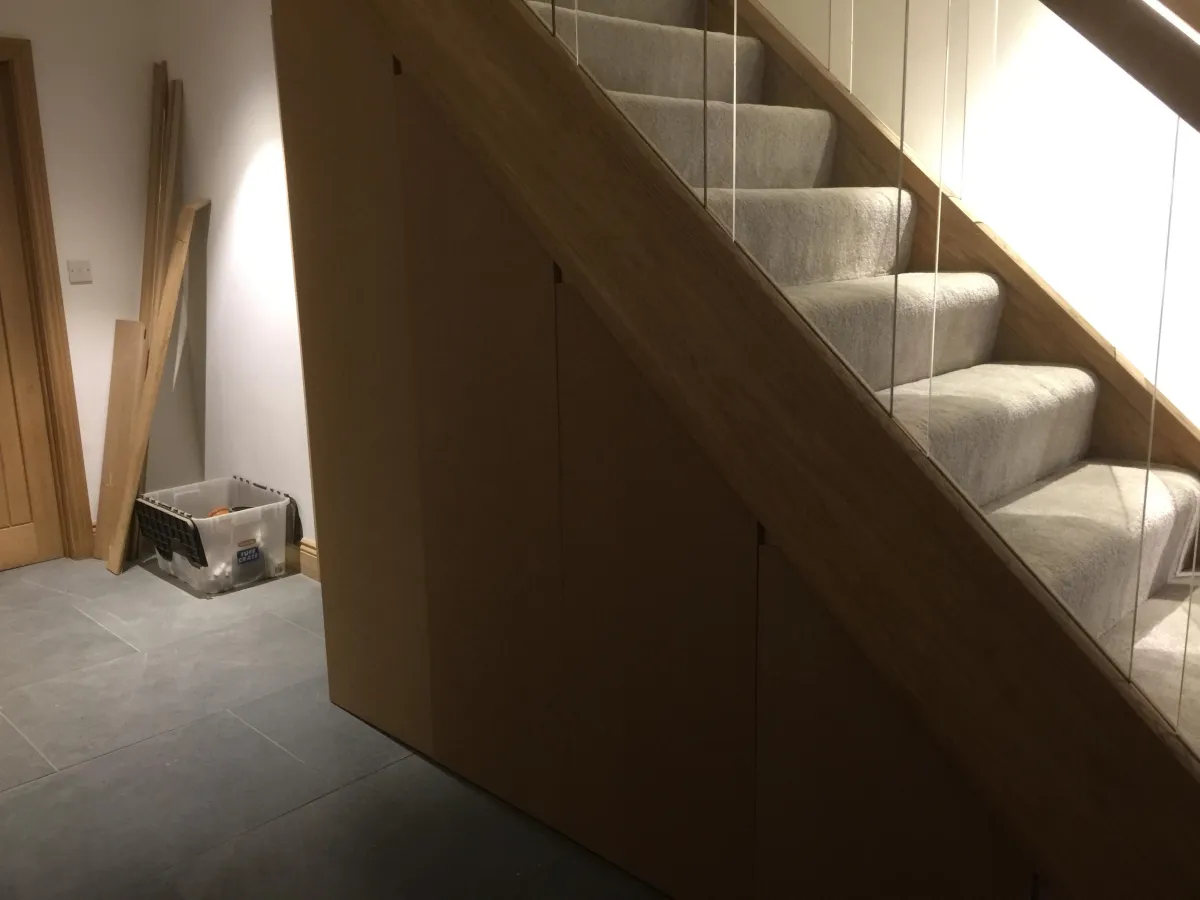
- If there's access to the underside of the stairs — a cupboard, an open soffit — look for wedges that have visibly dropped out of their housings or glue blocks lying loose on the floor.
- Walk the flight and note whether the creak comes from the nosing of the tread or further back, which points towards which joint is affected.
- Push and pull the newel post at the top of the flight to check it's still rigidly fixed rather than rocking.
- On a wide flight with no central support wall or carriage, stand in the middle and compare the amount of deflection there with the deflection near the strings.
When it's a comfort issue and when it's a safety one
Most creaking staircases are a nuisance rather than a hazard — the loose wedges and fallen glue blocks affect how the stairs sound and feel but not their basic ability to carry you safely. That said, a staircase should never actually feel unsafe to use.
A newel post that rocks, a handrail that moves under load, or a balustrade with any give in it is a different category and should be treated as a safety item rather than something to live with. If in doubt about the structural adequacy of a flight, particularly on an older or altered staircase, that's a job for a qualified assessment rather than guesswork from underneath with a torch.
Common questions
Is a creaking staircase dangerous?+
On its own, usually not — most creaking comes from dried joints and lost glue blocks rather than a loss of structural capacity. It becomes a safety question if the newel post, handrail or balustrade also has movement in it.
Can I just tighten the treads from above?+
You can screw and pellet from above where there's no underside access, and it does work, but it's treating the same joint from the less effective side. Where access from beneath exists, re-wedging and re-gluing there is the more thorough fix.
Why has my staircase suddenly started bouncing when it never used to?+
Sudden onset, rather than gradual worsening, is worth a closer look — it can mean a fixing has genuinely failed rather than joints simply drying out over time, particularly if it coincides with other changes nearby such as new flooring loads or altered use of the space above.
Arrange a free staircase inspection
We'll assess the flight from above and below where access allows, and quote in writing for whatever the actual cause turns out to be.