
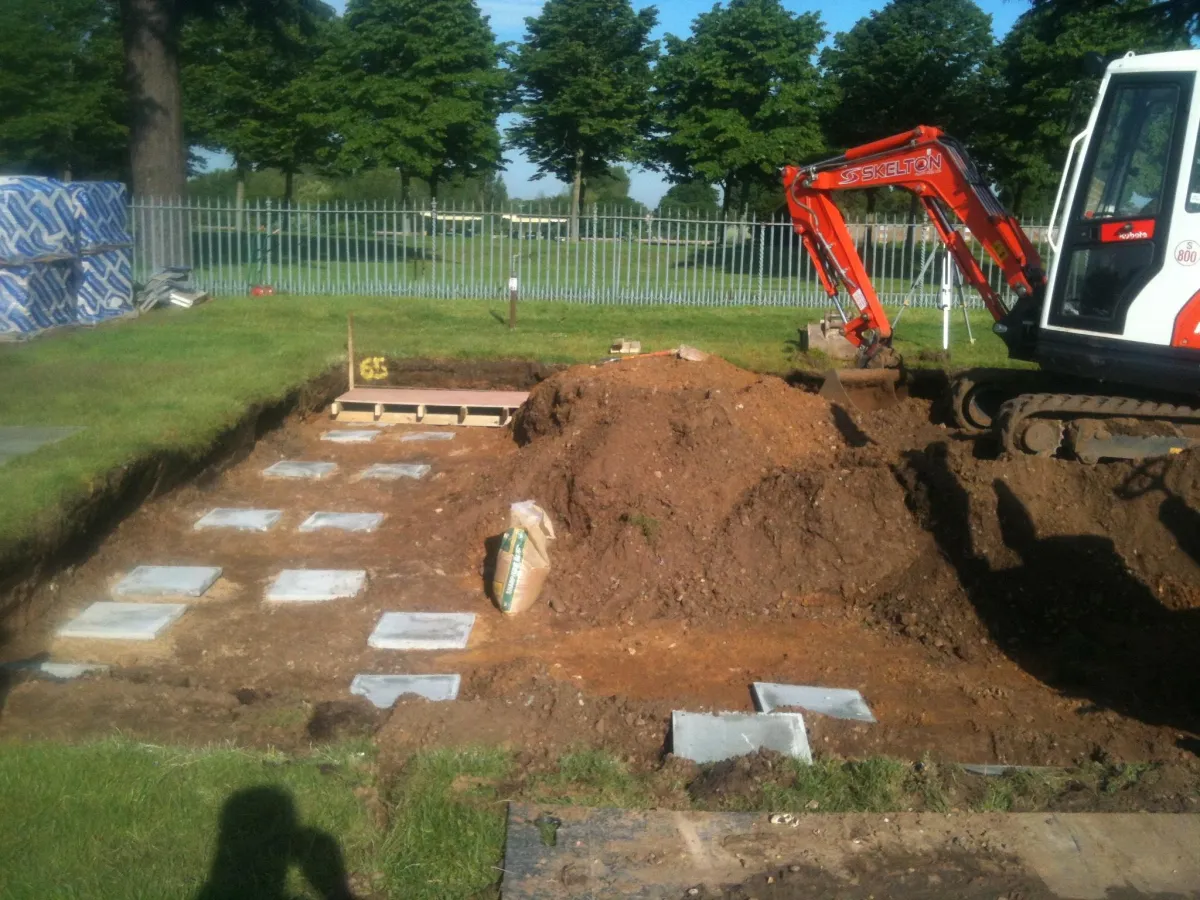
Where a proposed extension, outbuilding or driveway sits anywhere near a public sewer, a short list of checks before groundworks start can be the difference between a smooth start on site and a stalled trench waiting on paperwork. None of these checks are complicated, but they need doing early enough to still change the design if necessary.
The questions below cover the practical points worth confirming, whether you're relying on a contractor to manage this or checking it yourself before signing anything off.
Confirm whether sewer records have actually been checked
Ask whether sewer records have been obtained from the water authority for the site, and whether that check happened before the foundation design was finalised rather than as an afterthought. A design drawn without this check is a design that may need reworking once the records come back.
Where records show anything close to the proposed footprint, a physical survey — a trial hole or a CCTV run — confirms the actual depth and condition rather than relying on a plan that may be decades out of date.
Check whether a build-over agreement is actually needed
Not every nearby drain triggers a build-over agreement, but assuming it doesn't without checking is a risky shortcut. Confirming this early avoids finding out mid-groundworks that an application should have gone in months earlier.
- Has the distance from the sewer to the new structure been measured and compared against the water authority's threshold?
- Has an application been submitted, and is there a decision or a timescale for one?
- Is the proposed foundation design the one the water authority has actually seen?
Check that access to chambers and manholes is preserved
Any inspection chamber or manhole near the works needs to stay reachable both during construction and once the building is finished. Ask whether the design accounts for this, and whether an existing chamber cover will end up hidden under decking, paving or a new structure with no way to lift it.
This is easy to overlook at design stage and expensive to fix once paving or landscaping is complete, so it's worth confirming explicitly rather than assuming it's been considered.
Ask what happens if a surprise turns up
Even a careful survey can miss something — an old field drain, a redundant run, a shared pipe that isn't on any record. Ask in advance how the contractor would handle an unrecorded drain found during excavation, and whether that risk sits with the client or the contractor under the contract.
A clear answer here, agreed before digging starts, avoids an awkward negotiation over cost and delay at the exact moment the discovery is made.
Check the paper trail is complete before covering anything up
Before a trench or foundation gets backfilled, confirm that any build-over agreement, diversion record or survey report is actually in hand, not still 'in progress'. Building control will typically want to see this evidence, and it is far harder to produce retrospectively once ground has been reinstated.
Keeping copies of the agreement, the approved drawings and any correspondence with the water authority in one place means nothing has to be chased down later if a query comes up at sign-off.
Common questions
How do I find out if there's a public sewer near my site?+
The relevant water authority holds sewer records that can usually be requested for a small administrative fee, and these show the approximate line and depth of public sewers near a given address.
What if the agreement isn't in place by the time I want to start groundworks?+
Groundworks affecting the sewer shouldn't proceed without it — starting anyway risks having to redo work to meet the agreed foundation solution, on top of any enforcement risk from the water authority.
Does a build-over agreement cost anything?+
Water authorities generally charge an administration fee for processing an application, separate from any construction cost of the foundation solution itself. Check current fees directly with the relevant authority.
Get your drainage checked before groundworks are booked
We'll confirm what's below ground, what needs agreeing with the water authority, and what that means for your foundation design.