
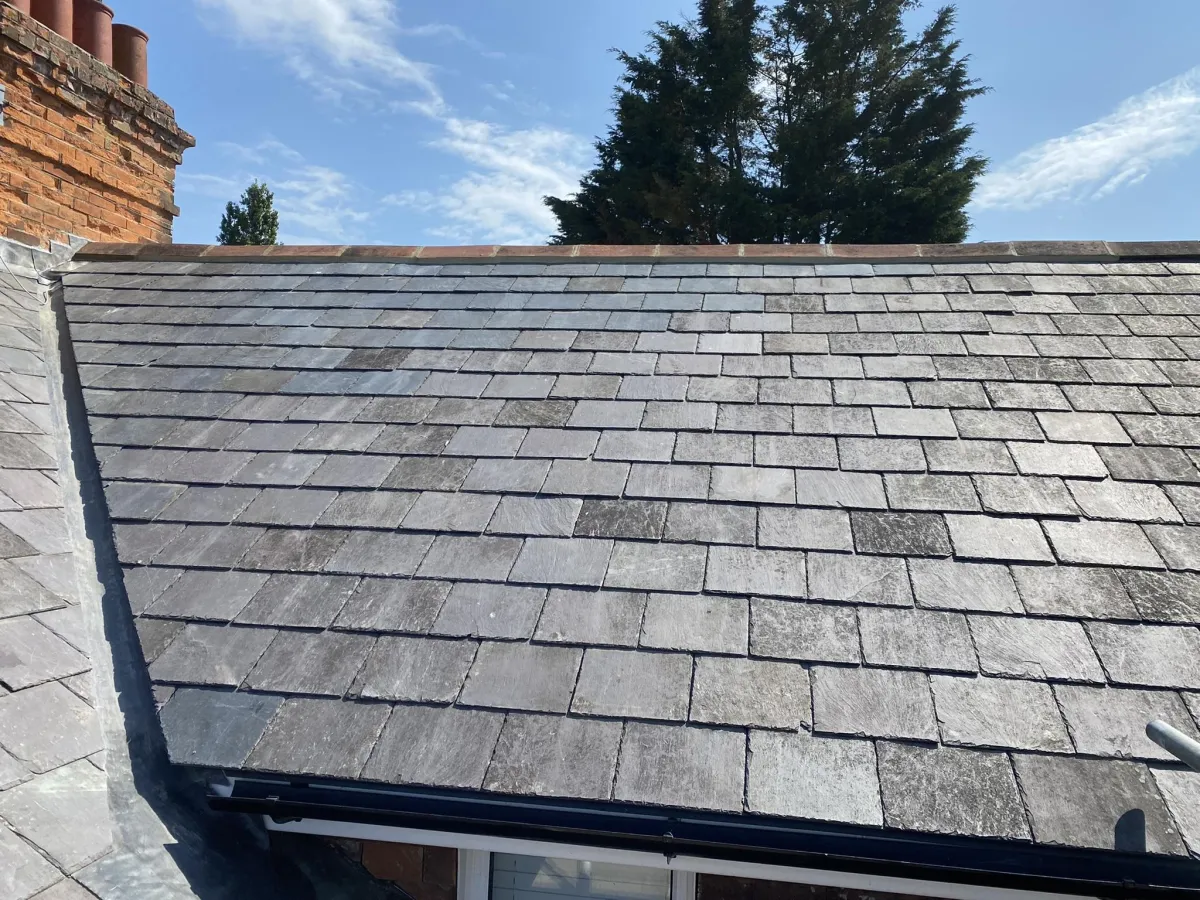
Nearly every re-roof we quote follows a period of patch repairs that gradually stopped resolving anything for long. The judgement call is knowing when that pattern has become the real problem, rather than treating each new leak as an isolated event.
What a patch repair actually fixes
A patch repair replaces the failed component — a cracked tile, a slipped slate, a section of flashing — and nothing else. It is the right answer when the rest of the roof, including the felt and fixings underneath, is sound and the fault is genuinely isolated.
The problem is that fixings, battens and underlay age at roughly the same rate across the whole roof, since they were installed at the same time. One failed nail is rarely the only nail close to failing.
The signs the pattern has shifted
Repeated callouts to different parts of the same roof within a short period, felt that is visibly perished or brittle when a tile is lifted, and fixings that pull out of the batten rather than holding are the signals that this has moved from occasional repair to systemic failure.
Once several of these show up together, a re-roof resets the whole covering, underlay and fixings at once rather than chasing individual failures one at a time as they surface.
Cost drivers for each route
A patch repair's cost is driven mainly by access — scaffold or a tower to reach the fault — rather than the material itself, which is why several small patch jobs over a few years can add up to a meaningful sum in access costs alone.
A full re-roof's cost is driven by covering material, the condition of the timber structure once exposed, and scaffold for the whole roof rather than one section, but it resets the clock on all of those elements at once.
What building control expects
A localised patch repair using like-for-like materials generally does not trigger Building Regulations involvement. A substantial re-roof, particularly where insulation levels are being upgraded at the same time, can fall under Building Regulations for thermal performance, so this is worth confirming before work starts rather than after.
What a written quote must make clear
A patch repair quote should state exactly what is being replaced and confirm whether the surrounding underlay and battens have been inspected, not just the visibly failed component.
A re-roof quote should state whether the price assumes sound timbers underneath or includes a contingency allowance for decayed rafters or purlins found once the old covering comes off, since this is the single most common cause of a re-roof quote changing once work starts.
Common questions
How many repairs is too many?+
There is no fixed number, but repairs to different parts of the same roof more than once a year, or repairs that recur in the same area after being fixed, both point toward underlying failure of the underlay or fixings rather than isolated damage.
Can I re-roof in phases to spread the cost?+
It is possible on a large or complex roof with distinct sections, but phasing means two scaffold visits and two sets of access costs rather than one, so it is rarely cheaper overall — only more manageable in terms of cash flow.
Does patching devalue the eventual re-roof?+
No, sound patch repairs are not wasted — they extend the roof's working life. The re-roof decision is really about the underlay and fixings, which patching cannot address, rather than about the visible tiles or slates themselves.
Will a full re-roof reveal problems a patch repair would not?+
Yes — stripping the whole covering exposes rafters, purlins and battens across the entire roof, which a patch repair to one section never does. This is why re-roof quotes often include a contingency for timber repairs that only becomes a firm figure once the covering is off.
Get your roof assessed honestly
We'll lift a sample of tiles or slates to check the felt and battens underneath before recommending patch repair or a full re-roof, and quote in writing.