
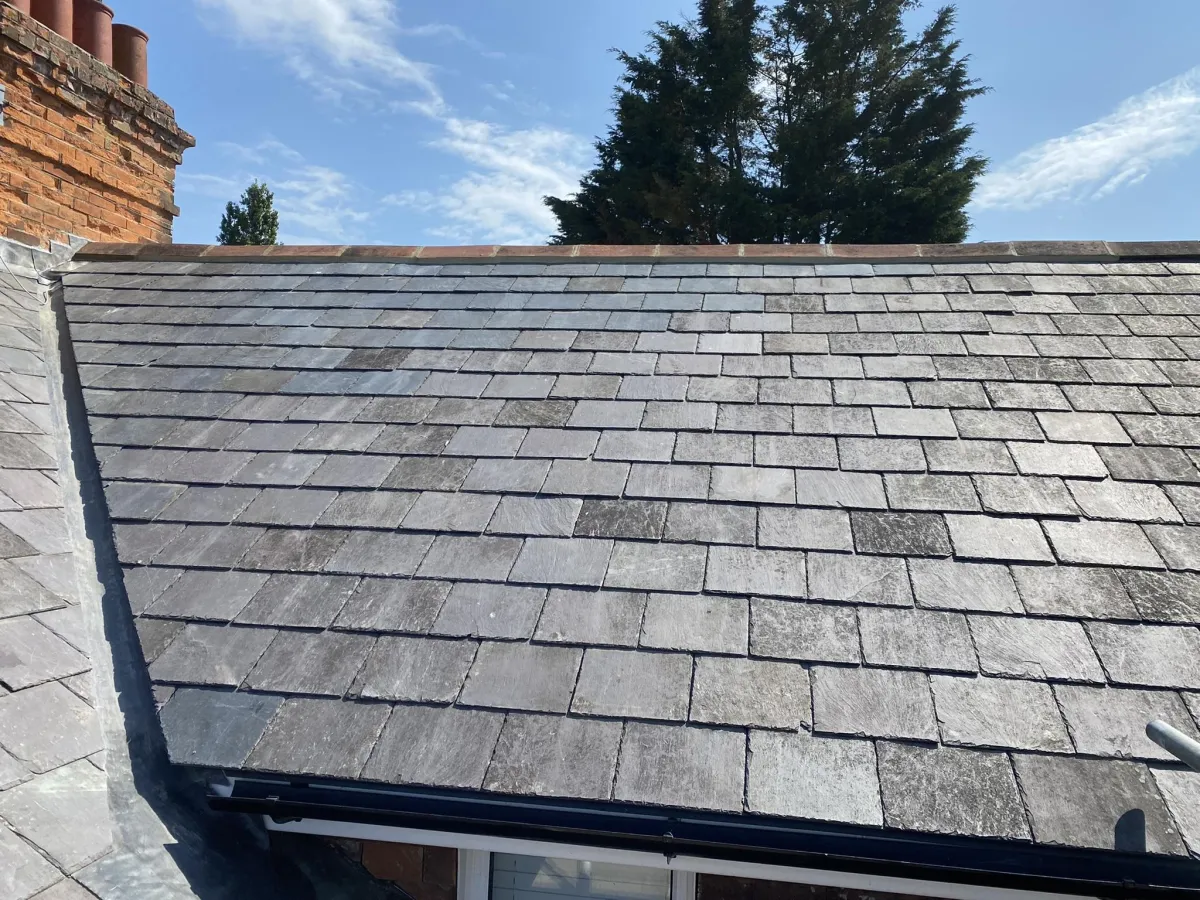
Natural slate is quarried stone, split by hand or machine into thin sheets and hung on battens with a calculated overlap called the head lap.
Across Kent's Victorian and Edwardian terraces and villas it's the roof covering that was originally specified, and matching or replacing like-for-like is usually the right instinct.
Where slate is the right call
On roofs pitched above around 30 degrees, slate sheds water quickly and the head lap does its job without strain. Victorian bay roofs, turret roofs and steep terrace pitches all suit it.
It's also the right answer wherever a conservation area or listed building consent requires a natural roof covering to match the streetscape, and where the existing roof timbers are sound enough to take the weight.
Where it's the wrong call
Shallow pitches below roughly 25 degrees push water back under the overlap in driving rain, whatever the slate quality. On those roofs we specify a different covering entirely rather than fight the geometry with sealant.
It's also the wrong call where the budget can only stretch to a low-grade imported slate. Thin, inconsistent slate delaminates within a couple of decades, and a roof stripped and re-covered that soon has cost more than doing it properly once.
Grading and origin
Welsh slate is graded by thickness, size and the number of usable years the quarry expects from a batch; Spanish and other imported slates vary far more between suppliers, so we ask for evidence of the specific batch rather than a generic product sheet.
For a roof meant to last, we specify slate with enough thickness to resist delamination and a consistent enough colour run that patch repairs in ten years' time won't stand out.
What we specify instead when slate doesn't fit
On shallow-pitch extensions we'd specify a single-ply membrane or a concrete or clay interlocking tile rated for that pitch, not slate forced below its limit.
Where budget rules out a decent slate grade, a well-made concrete slate substitute at the right price point often outperforms a poor-quality natural slate over the same period, and we'll say so in the quote rather than sell a compromise as the real thing.
Common questions
Can I mix reclaimed slate with new stock on the same roof?+
Yes, and it's common practice — reclaimed slate is graded and sorted by size, with the best pieces used on the most visible slopes and smaller pieces toward the ridge. We'll tell you up front if the reclaimed stock we've sourced isn't consistent enough to use.
How do I know if my roof pitch is steep enough for slate?+
It's measured in degrees from horizontal, not guessed by eye. We check it on the free site visit along with the head lap the existing roof uses, and we'll tell you plainly if the pitch is marginal before recommending slate.
Is natural slate always more expensive than a tile alternative?+
Not always — reclaimed and mid-grade slate can land close to a good concrete tile once you account for weight-related structural checks. It depends on grade, origin and how much of the existing structure and battens can be reused.
Book a free roof assessment
We'll check your pitch, grade the existing slate and tell you honestly whether it's worth keeping, repairing or stripping.