
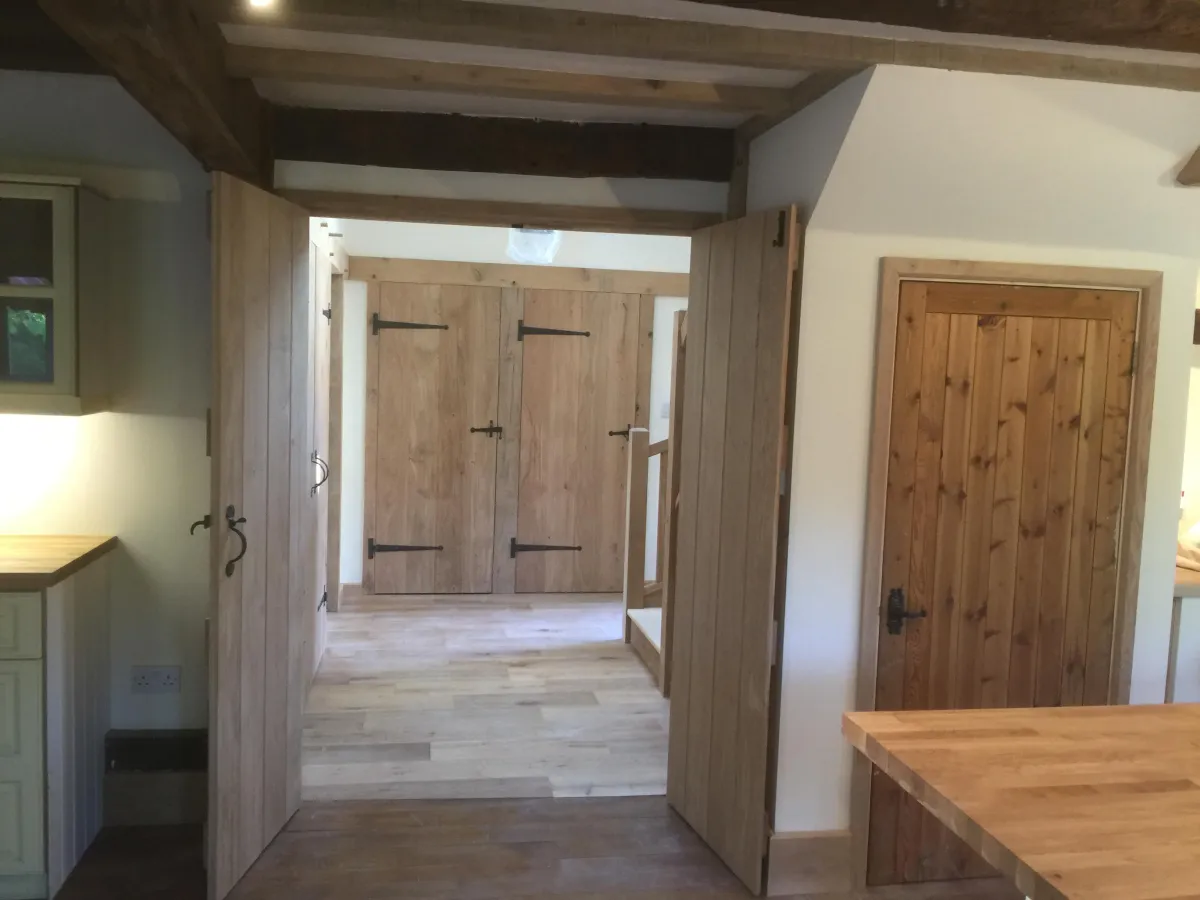
For fitted wardrobes, alcove units and bookcases, the choice between painted MDF and solid hardwood is one of the most common decisions in bespoke joinery — and one where the wrong assumption (“hardwood is always better”) often leads to the wrong result.
Both are legitimate, well-established choices. What matters is matching the material to the finish you actually want to live with.
Dimensional stability
MDF is an engineered board with no grain direction, so it doesn't expand, contract or warp with seasonal humidity changes the way solid timber does — doors and panels stay flat and true for decades.
Solid hardwood moves with moisture, which a good joiner allows for in the construction — frame-and-panel doors rather than solid slab doors, for instance — but it needs designing for from the outset, not bolted on as an afterthought.
Finish and appearance
Sprayed MDF gives a completely flat, factory-quality painted finish with no visible grain, ideal for a clean, contemporary look or where the joinery needs to match painted woodwork elsewhere in the house.
Hardwood shows real timber grain and colour, which develops genuine character and patina over years — something no paint finish can replicate, but it comes with visible grain and colour variation piece to piece that some clients don't want.
Where failures actually happen
MDF's main vulnerability is moisture — it swells and cannot be dried back out at cut edges or where water sits, so it's the wrong choice tight to a bath or shower unless it's a genuinely moisture-resistant grade, well sealed at every edge.
Hardwood's failures are almost always at joints that weren't designed to allow for movement, or finishes that weren't maintained — an oiled hardwood surface needs periodic reapplication that a painted MDF surface doesn't.
Weight and installation
MDF is heavy for its size but consistent, which makes fixing runs of fitted furniture to a wall straightforward once the correct fixings are chosen for the wall type.
Solid hardwood carcasses and panels are often heavier still, and large hardwood doors need substantial, well-aligned hinges to avoid sagging over time — a detail that matters more with solid timber than with lighter MDF panels.
What drives the cost difference
MDF cost is driven mainly by the spraying and finishing process rather than the board itself, since sheet material is relatively inexpensive compared with solid timber.
Hardwood cost is driven by the species chosen, the amount of solid timber used versus veneered panels, and the extra joinery time needed to build in allowance for seasonal movement — decisions that are worth discussing at quote stage rather than after the timber has been ordered.
Common questions
Can MDF and hardwood be combined in one piece of furniture?+
Yes, this is common practice — MDF carcasses and doors with solid hardwood edging, worktops or feature elements combine MDF's stability with real timber where it's seen and touched most.
Is hardwood always more expensive than MDF?+
Generally yes, because of the raw material and the extra care needed in construction, but the gap varies enormously by species and complexity — it's not a fixed multiple.
Which is better for a bathroom or utility room?+
Neither standard-grade MDF nor most hardwoods are ideal in consistently wet conditions — a moisture-resistant board or a naturally durable hardwood species, properly sealed, is the safer specification there.
Discuss materials for your fitted joinery
We'll specify the right board or timber for where the piece is going, not just what looks good in a showroom — free site visit, written itemised quote.