
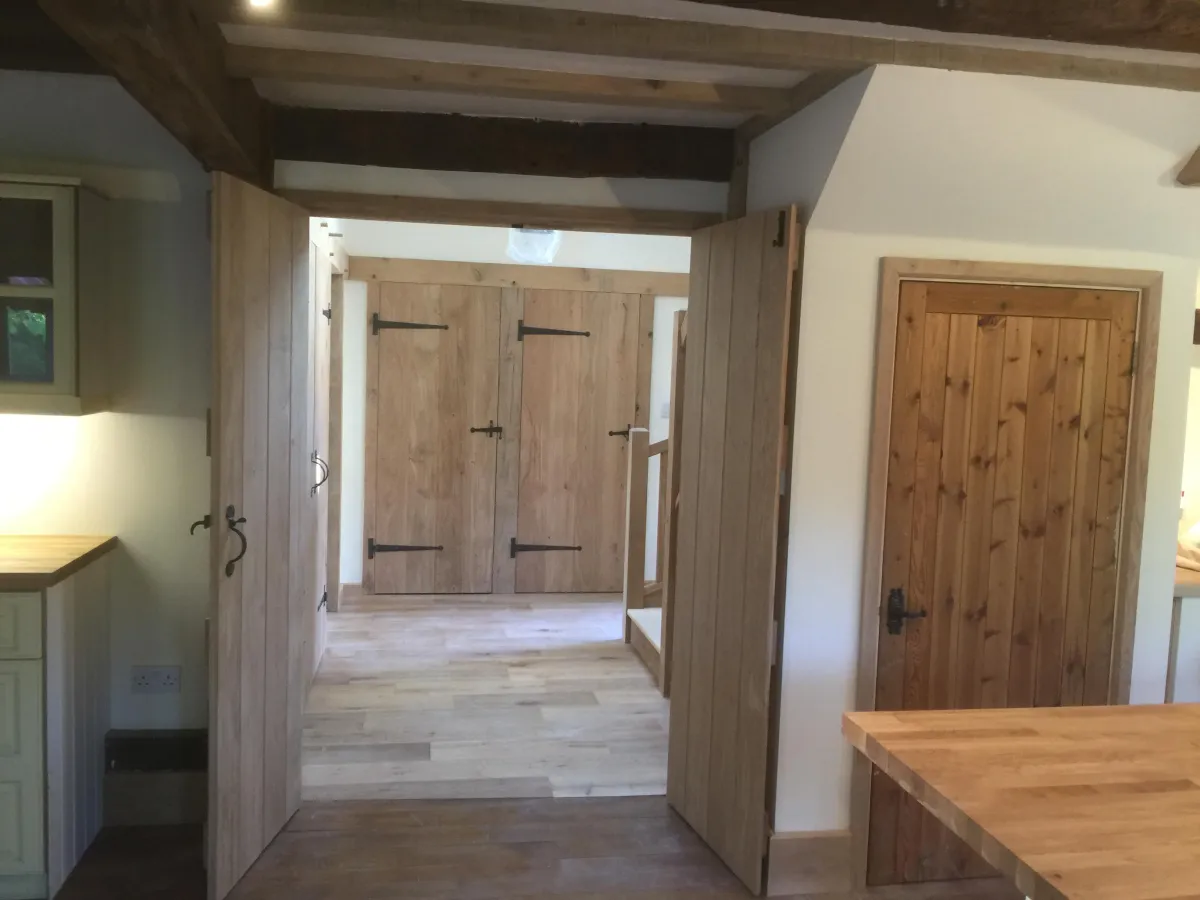
Kiln-dried softwood — mostly redwood and whitewood carcassing stock — is dried in a controlled kiln to a target moisture content before it's machined, which is what separates it from air-dried or green timber bought straight off the yard.
It's the default structural and first-fix timber on almost every job we run, but that doesn't mean it's right for every visible or exterior application.
Where it's the right choice
Studwork, joists, roof carcassing, first-fix framing and painted joinery all rely on kiln-dried softwood because the controlled moisture content means it won't shrink and twist significantly after it's fixed in place — the main cause of nail-popping and cracked plasterboard joints when green timber is used instead.
It's also the correct base timber for anything that's going to be painted rather than left natural, since paint hides the grain and knot pattern that would otherwise matter.
Knot grade and finger-jointing
Softwood is graded by knot size and frequency. A clear or near-clear grade costs more and is used where the timber will be seen and stained or oiled rather than painted; a standard carcassing grade with more and larger knots is perfectly adequate structurally and is what's used behind plasterboard or under paint.
Finger-jointed softwood — short lengths joined end to end with a machined interlocking joint — is now common in painted joinery lengths and is a legitimate, stable product once painted, though it should never be specified for anything left in a natural or clear-finished state where the joints would show.
Where it's the wrong material
Anywhere it will be exposed to the weather without a maintained paint or preservative system, standard kiln-dried softwood will decay far faster than a modified timber like Accoya, particularly at end grain and ground contact points.
For exposed, natural-finish joinery where the timber itself is the feature, softwood's knots and colour variation usually don't give the look the client wants, and oak or a stable hardwood veneer product is the better call.
Fixings for softwood joinery
Standard bright or zinc-plated screws and nails are adequate for internal, permanently dry softwood, but anything going outside or into a damp-prone area — sills, sub-frames, fascia boards — needs a stainless or hot-dip galvanised fixing, since a corroding fixing in exterior softwood streaks the surrounding timber and eventually loses its grip in the softening wood around it.
Adhesives used alongside fixings also need matching to the exposure: an interior-grade wood glue used on an external joint will fail well before the timber itself shows any sign of wear.
Moisture content on delivery and site storage
Kiln-dried softwood arrives at a controlled moisture content, but it will pick up or lose moisture again if it's left stacked outdoors or in an unheated, damp store before it's fixed, so how it's stored between delivery and installation matters as much as the drying process it went through at the mill.
Timber fixed into a building before the wet trades — plastering, screeding — have dried out will absorb moisture from the surrounding structure regardless of how well it was kiln-dried beforehand, which is one of the more common causes of joinery moving after a job that otherwise looked finished correctly.
Common questions
What moisture content should kiln-dried softwood arrive at?+
Carcassing and joinery softwood typically arrives at around 18-20% moisture content or lower for internal joinery, well below the 30%+ common in green or unseasoned timber. That target is what stops it shrinking significantly once it's fixed on site.
Is finger-jointed timber a lower-quality product?+
Not for its intended use. Once painted, a finger-jointed length performs just as well structurally and dimensionally as a single-piece equivalent, and it's a sensible way to use timber efficiently. It's only wrong where the joints would be visible in a clear finish.
Can kiln-dried softwood be used outdoors?+
Only with a preservative treatment and a maintained paint or stain system, and even then it will need more frequent attention than a naturally durable or modified timber. For anything low-maintenance outdoors we'd generally recommend Accoya or cedar instead.
Ask us which softwood grade your job needs
We'll specify the right grade for structural, painted or exposed work rather than a single grade for everything.