
Two quotes for the same wardrobe run in oak veneer can differ significantly, and the reason is rarely the labour. It's the board specification — a line most homeowners never see broken out, which is exactly why it's the first place a cheaper quote cuts.
Understanding what's driving the price helps you read a quote properly and ask the right question when a rival number looks too good.
Veneer grade and thickness
Veneer is sold in grades based on how much of the timber's natural character — knots, sapwood streaks, colour variation — is allowed through. A higher, more consistent grade costs more per sheet.
Thickness also varies between suppliers. A thicker veneer costs more but tolerates future light refinishing; a thin veneer is cheaper but has effectively no margin for a future re-sand.
Core material
Moisture-resistant MDF cores are the cheaper option and perform well in normal rooms. Plywood cores cost more but hold screws and hinges better over repeated door use, which matters on frequently opened wardrobe or cupboard doors.
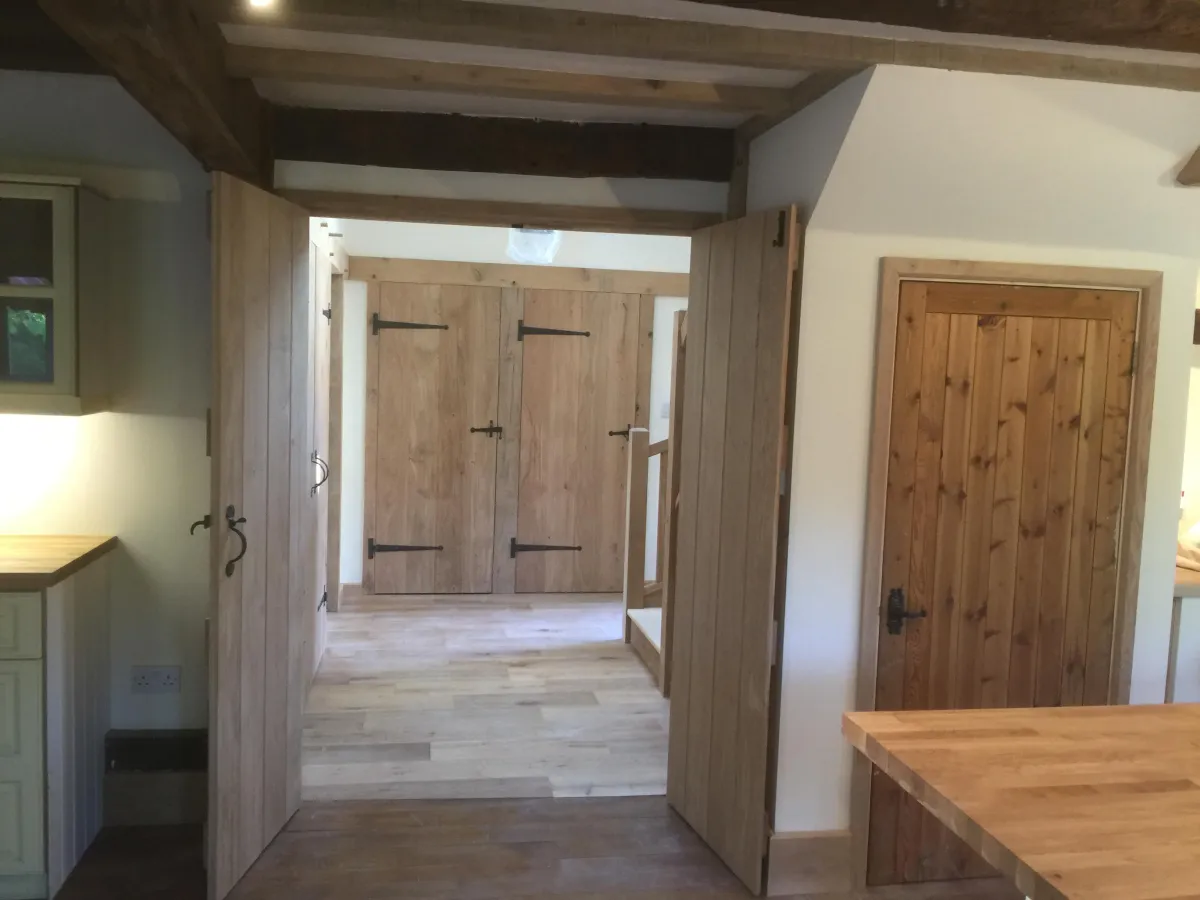
Lipping and edge detail
Solid oak lipping glued and profiled onto every exposed edge is labour-intensive — it has to be applied, planed flush and blended into the veneer grain. This is one of the most commonly dropped items on a cheap quote, replaced with a raw or iron-on edge banding that chips within a year or two.
Panel size, matching and wastage
Book-matched or slip-matched veneer runs across a set of doors cost more because the sheets have to be cut and laid in sequence from the same veneer flitch, with more wastage at each edge to keep the grain aligned.
Larger single panels also cost more per square metre than the same area split across smaller doors, because full sheets are used less efficiently and handling a large flat panel without damage takes more care.
Reading the quote
A proper quote will separate board specification, lipping, hinges and fittings, and finishing as distinct lines. If a quote just says 'oak veneer wardrobe doors' as one figure, ask what core, what veneer grade and whether lipping is included before comparing it to anything else.
- Veneer grade and thickness
- Core material — MDF or plywood
- Solid lipping on exposed edges
- Grain matching across a run of doors
- Finish — oiled or lacquered
Common questions
Why is one veneer quote so much cheaper than another?+
Almost always a thinner veneer, an MDF core swapped in where plywood was assumed, or lipping dropped in favour of raw or iron-on edging. Ask for the board spec in writing.
Does matching the grain across doors cost more?+
Yes, because the veneer sheets must be cut in sequence from one flitch and laid in order, which increases wastage and handling time compared with using sheets in whatever order is cheapest.
Is a plywood core worth the extra cost?+
On doors that get opened and closed daily, generally yes — it holds hinge screws better over years of use than MDF. On fixed panelling it matters less.
Get an itemised quote for veneer joinery
We provide a written, itemised quote showing board core, veneer grade and edge detail so you can compare it properly against anything else you've had priced.