
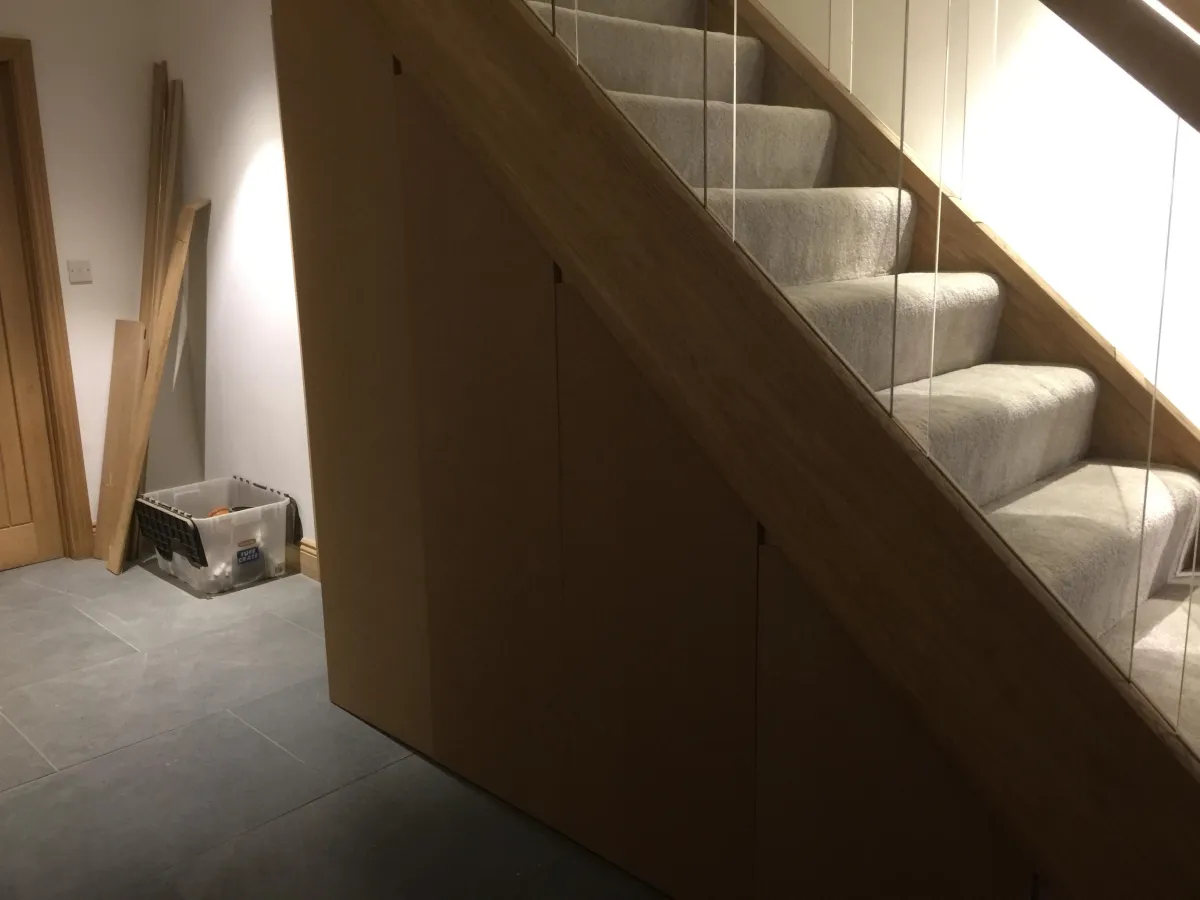
The cupboard under the stairs is the least ventilated, least heated and most cluttered space in most houses, and it usually sits against an external or party wall with a stopcock, a meter and sometimes a drain nearby. Damp shows there before it shows anywhere else.
Three causes cover nearly all of it: condensation in an unventilated box, a small plumbing or drainage leak, and ground moisture coming through a solid floor or a bridged damp course. Telling them apart is straightforward once you know what to look for.
Condensation, the most common cause
A closed cupboard with no heat and no air movement will sit several degrees colder than the hall. Moist air drifts in when the door opens, hits the cold wall and condenses. You get a musty smell, mould on cardboard and fabric, and a damp feel to the wall with no defined tide line.
The giveaway is that mould grows on the contents as much as on the structure, and the problem is worse in winter. Fixing it means airflow and warmth rather than damp proofing: a vented door or a grille top and bottom, no shelving pressed flat against the wall, and keeping soft goods out of there.
Leaks, and where to look
Understairs cupboards attract plumbing. The mains stopcock is often there, sometimes a washing machine waste, a downstairs cloakroom on the other side of the wall, or a heating pipe run. A slow weep at a compression joint puts out very little water but keeps a patch permanently damp.
Wrap kitchen roll around every joint you can reach and check it the next day. Look at the base of the wall shared with any bathroom or cloakroom. If the patch never changes with the weather and never dries, plumbing is the first suspect, not the ground.
- Stopcock and mains joint weeping
- Waste pipe from a cloakroom or kitchen on the other side of the wall
- Old lead or steel pipe under a solid floor
- Blocked or cracked drain running past the wall outside
Ground damp and bridged damp courses
In houses with solid floors and no membrane, or where a suspended timber floor has lost its underfloor ventilation, moisture rises into the base of the wall. You see a tide line up to around a metre with salt deposits, and skirting boards that are soft at the back.
Outside the same wall, check whether a path, a raised border or a render coat has been taken above the damp course. That bridge is the single most common man made cause. Also check the airbricks. Understairs cupboards often sit over the section of underfloor void that has had its airbrick blocked by a later extension or by a flower bed.
Getting rid of a musty smell in the cupboard under the stairs
A musty smell under the stairs is mould or damp timber, and air fresheners only hide it. Empty the cupboard, check the floor, skirting and the bottom of the wall with your hand for coldness or softness, and look at what is on the other side of the wall: an outside wall, a bathroom or a kitchen sink run are the usual suspects.
Once the cause is dealt with, ventilation keeps the space fresh. A vented door or grille lets air move, a gap left under the door helps, and keeping stored items off the floor and away from the wall stops pockets of still, damp air forming.
- Vented door panel or a discreet grille
- Stored items raised on slatted shelves
- Air bricks outside kept clear of soil and paving
- Any leak or rising damp fixed before redecorating
Repairs in the right order
Fix water at source first: the leak, the ground level, the blocked airbrick, the failed gutter or gully outside. Then let the wall dry, which takes weeks rather than days on solid masonry.
Only then decide whether any lining or replastering is needed. In older homes with solid walls, breathable lime plaster is usually a better answer than a cement render and a waterproof additive, which traps the moisture and pushes it further up the wall.
Finally, deal with the ventilation, because even a perfectly dry cupboard will smell musty if no air moves through it. A vented door and a small gap under it does more good than most treatments sold for the purpose.
Want a professional to handle it?
Free site visit, fixed-price written quote and a 5 year workmanship guarantee — backed by 40+ years on the tools and our workshop in Biddenden.
"We had our loft insulated and boarded. From start to finish the process was smooth, professional and stress-free. Malcolm upgraded the insulation and …"
Common questions
Is understairs damp usually rising damp?
Less often than people expect. Condensation in an unventilated cupboard and small plumbing leaks account for the majority. Genuine ground moisture is real but is a minority of the cases we are called to.
Why does the cupboard smell musty even when it looks dry?
Because there is no air movement. Mould spores on stored fabric and cardboard produce the smell at humidity levels that leave the wall looking perfectly normal.
Do I need a chemical damp proof course injection?
Only where a genuine failed damp course has been proven and the wall type suits it. Very often the real fault is a bridged damp course outside, which is cheaper to fix and does not involve injecting anything.
Can I put a radiator or heater in there?
Gentle background warmth combined with ventilation helps a great deal. Heat on its own without airflow simply moves the condensation to the next coldest surface.
Will you look at it before quoting?
Always. We visit, work out which of the three causes you have, and give you a written price for the work that is genuinely needed.
How do I ventilate a cupboard under the stairs?
Fit a vented door panel or grille, leave a small gap under the door and keep stored items off the floor and away from the wall so air can move.
Why does my under stairs cupboard smell musty?
Usually mould or damp timber caused by a leak, moisture through an outside wall or floor, or a lack of air movement.